
Reviewed · BUKHARA TOURS
Bukhara Walking Tour
Bukhara’s old town packs an unusual one-two punch: major Islamic architecture and small surprises like the Central Asian puppet theater. I love how the route connects places where people lived, prayed, traded, and gathered, not just photo stops. I also like that the tour leans into street-level storytelling at Lyabi Hauz, the living social heart of the city at day and especially in the evening. The only drawback: monument entry fees are not included for the stops that require tickets, so you will want to budget a little extra.
You’ll walk with a professional guide in multiple languages (English, Spanish, French, German, Russian), and the experience runs as a true private tour for your group. In past tours, guides such as Nilufar and Peri stood out for being patient, punctual, and consistently clear in English, which makes the stories easy to follow. This is a half-day walking format, so wear comfy shoes and expect you will cover a lot of ground.
Key highlights at a glance
- Lyabi Hauz as your lively starting point, surrounded by historic madrasas and a dervish retreat
- Central Asian puppet theater history, including a brief show from the master
- Magoki Attori Mosque and carpet-related viewing, a fast stop with real context
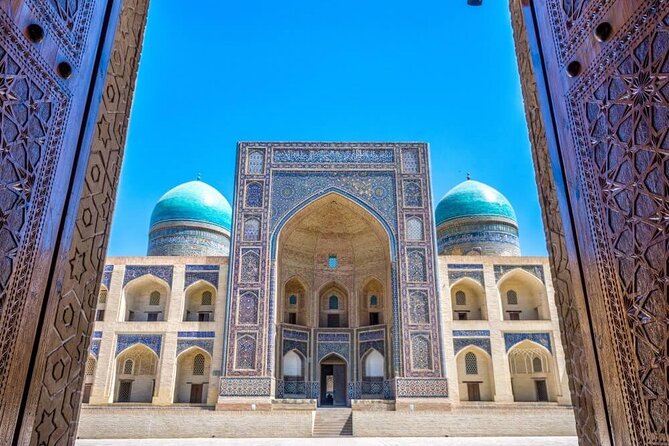
- Poi Kalan complex, anchored by the tall Kalan minaret and the city’s grand mosque
- Ark of Bukhara as a winter residence and a “city within the city” feeling
- Samanid Mausoleum as the finale and one of the earliest major mausoleums in Central Asia
Why Bukhara’s architecture makes the walking feel worth it
Bukhara is the kind of city where a walk is also a lesson. You’re not just moving from one landmark to the next. You’re stepping through the way the city used to organize life around religion, education, trade, and civic power.
This tour works because it strings those pieces together in a logical flow. You start in a courtyard-meets-street space where locals gather, then you move into the madrasas and mosques that defined the skyline, and you end at the mausoleum that marks an early turning point for Central Asian Islamic architecture. Even if you have only a few hours, you’ll get a coherent picture of what Bukhara is.
More Walking Tours in Bukhara
- Bukhara: Walking Tour with a Small Group
★ 4.9 · 260 reviews - All You Need To Know About Bukhara. A Walk In The Town
★ 4.9 · 31 reviews - Bukhara Walking Tour
★ 4.7 · 25 reviews
Getting oriented at Lyabi Hauz, where the city breathes
The walk starts at the Lyabi Khause ensemble near the Divan-Beghi area. Lyabi Hauz is the kind of place you feel immediately, because it’s built around water and designed for people to meet. In the evening it becomes especially animated, and it is one of the reasons guides begin here before you head into the quieter, more monumental zones.
Around this core you’ll see major pieces of the Lyabi Hauz complex, including the Kukaldosh madrasah and the Nadir Divanbegi madrassah. You’ll also have a look at the hanaka, a dwelling associated with dervishes. That matters, because it signals that this city wasn’t only about courts and scholars. It also supported religious life that was lived, shared, and repeated day after day.
Two practical notes help you enjoy this stop. First, take a minute just to watch how the space is used. Second, pay attention to what your guide points out about the layout, because later mosques and madrasas make more sense when you already understand how the city’s spaces connect.
Puppet theater history in Bukhara: short show, big meaning
One of the most distinctive parts of this walking tour is the stop for the History of Bukhara Puppet Theatre. This is described as the only place in Uzbekistan where you can get acquainted with the history of Central Asian puppet theater, and that uniqueness is exactly why it earns a spot on a monument-heavy route.
You won’t be waiting around for hours. The format includes a brief two minute show from the master himself. And if luck smiles, you might also get the chance to see some puppet items. Even with a short viewing window, the goal is context: how stories traveled, how performance worked, and how crafts connected to cultural life.
Why I think this is smart in a walking tour: it breaks the pattern. After several religious and educational monuments, the puppet stop gives you something human and artistic. It also adds variety without costing you much time.
Magoki Attori Mosque and the carpet stop: small but loaded
Next up is Magoki Attori Mosque. The guide frames it as the first mosque in Uzbekistan, with a pre-Mongol period monument status. That long timeline helps you understand why this site feels layered: it sits at the intersection of what people believed before Islam and what came after.
The stop also includes a carpet museum angle. That pairing may sound random if you expect only stone and tile, but in Bukhara, textiles belong in the story. Patterns, craft traditions, and everyday goods often carried meaning similar to architecture, especially when trade and religious culture mixed over centuries.
This is a short stop, so the best way to get value is to listen closely to what your guide says about why the mosque is where it is and what it suggests about older urban life. If you love details, this one gives you a quick hit.
More of Bukhara worth pencilling in
- Bukhara Historical City Highlights Guided Walking Tour
★ 4.5 · 16 reviews - Bukhara: Private Guided Walking Tour with Hotel Pickup
★ 5.0 · 11 reviews - Bukhara: Walking Tour with a Small Group
★ 5.0 · 10 reviews - A Group Walking Tour Of Old Town
★ 5.0 · 8 reviews
Ulugbek and Abdulaziz-Khan madrasas: school buildings with swagger
Two madrasas follow, and together they show you how Bukhara valued education as both a spiritual and a social institution.
First is the Ulugbek Madrasah, described as the oldest madrasa in Bukhara and the only Timurid period monument in the city. Even if you are not a architecture scholar, you can feel the weight of that claim. Older schools are often simpler in layout, but they carry a sense of origin and continuity.
Then comes Abdulaziz-Khan Madrasah, called the most magnificent madrasa of Bukhara and noted as the first monument where the yellow color began to be used. That color detail matters. It’s the kind of cue that helps you read the city visually as well as historically. Your guide will likely point out how these color choices and building features were not just decorative, they were part of how power and patronage showed up in daily life.
A consideration here: entrance tickets are not included for these monument stops. So if you want to go inside, check what is required and have a little buffer time and money.
Trading domes and everyday Bukhara: the parts people miss
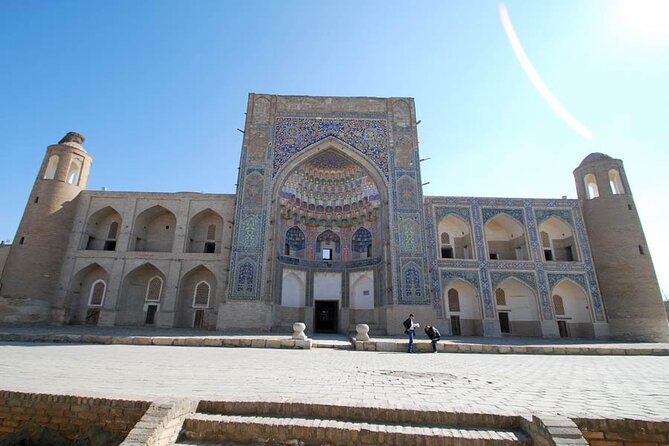
Between the headline monuments, you may also pass areas tied to commerce, including the Trading Domes (three domes), plus you get the chance to see the Jewish quarter. The point is not to turn this into a history lecture. It’s to show you how Bukhara’s monumental centers were supported by neighbors, merchants, and mixed communities.
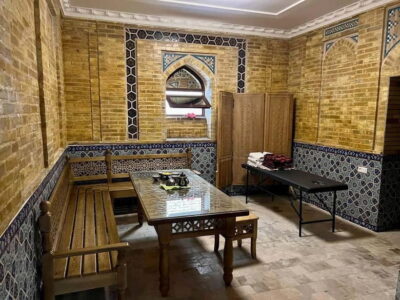
If your timing works out, you can also catch the reception of a 16th century traditional men’s bathhouse. The tour description frames it as only the reception, which is a useful heads-up: you are not touring the whole bath complex, you are seeing a slice. Still, that slice is valuable because it reminds you that daily rituals mattered just as much as public ceremonies.
This is also where the walking format pays off. In a car, you miss these transitions. On foot, you can actually connect the dots between commerce, craft, and the institutions of faith.
Poi Kalan complex: the skyline moment that explains everything
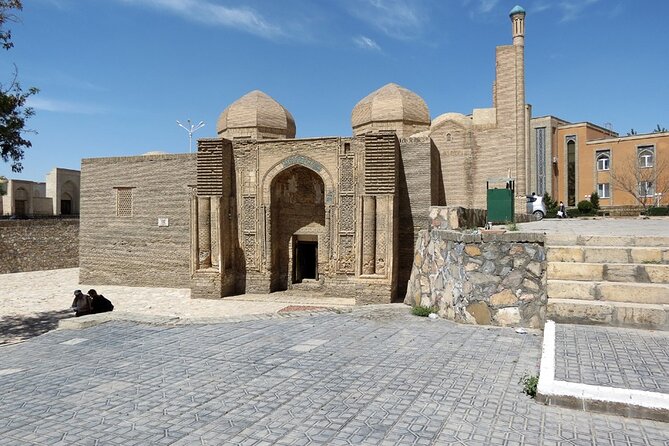
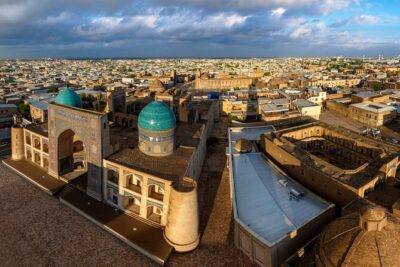
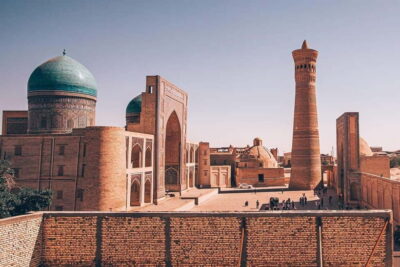
When the route reaches Poi Kalan, it becomes clear why Bukhara earned its reputation as a major spiritual and cultural center. Poi Kalan is a complex built around three monuments, including the Kalan minaret and the Kalan mosque, plus the surrounding structures that make the whole area feel like the city’s core.
The Kalan minaret is described as the highest minaret in the city and a pre-Mongol monument. That means it is not just tall, it is old in the way that changes how you think about the city’s survival through centuries of upheaval.
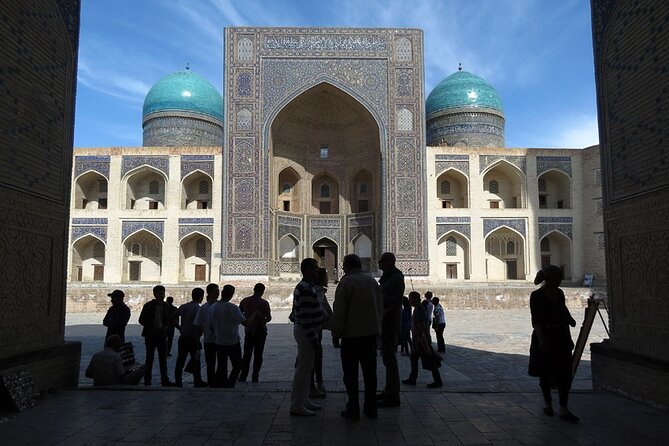
The Kalan mosque is described as the medieval largest mosque of the city, restored. Even when you only view the exterior or portions, it communicates scale and authority. Then you may also see the nearby Miri Arab madrasa, noted as the current madrasa for males. That detail is important because it signals the site is not museum-only. It continues in an active role.
One more stop in this section is the Poi Kalyan complex time block. You’ll usually feel it as your first real “wow” stretch. Take a moment to look back at the minaret and mosque from different angles while you still have energy. This is one of those times when the city rewards you for moving two steps left or right.
Ark of Bukhara: a city inside a city
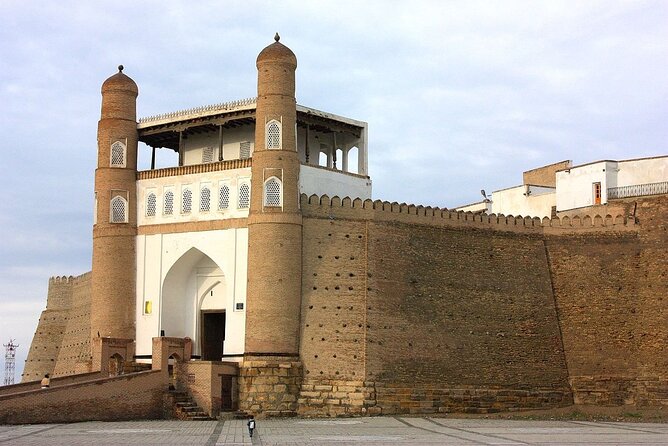
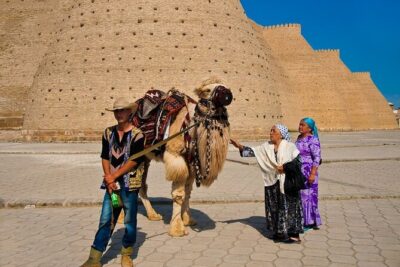
After Poi Kalan, you head to Ark of Bukhara. This is described as the winter residence of Bukhara’s emirs and a “city within the city.” That phrase is not just poetic. It suggests a fortified world of power, storage, administration, and daily leadership routines, all contained inside one broader complex.
It’s a different kind of architecture than mosques and madrasas. Here the focus is authority and control. You can read Ark as the political counterpart to the religious institutions you’ve already seen.
This stop is shorter, but it helps you rebalance your mental map. Bukhara is about faith and learning, but it is also about governance and power structures. Ark is where those threads come together.
Bolo Hauz, Chashmai Ayub, and the fun trick of reflections
The next stretch includes three sites that feel different in mood and function.
First is Bolo Hauz Mosque, also called Chilustun or 40 columns, even though it has 20 columns. The explanation you get during the stop is the payoff: in the reservoir reflection, you can perceive something else that makes the idea of 40 columns make sense. It’s a neat example of why Bukhara’s architecture is not only physical. It is also about light, water, and how people experienced buildings from specific viewpoints.
Then you move to Chashmai Ayub Mausoleum, described as the water supply museum of Bukhara, and also as the mausoleum of “St. Jehovah.” That specific pairing is one of those details that keeps Bukhara from being a one-note story. Water systems and sacred memory share the same spaces here, which is a reminder that practical infrastructure was tied to belief.
Both of these stops are shorter. So instead of trying to photograph everything, pick one or two angles your guide points out and absorb the explanation. Those are the moments that make the short time feel fully used.
Samanid Mausoleum: early Central Asia at the end of your walk
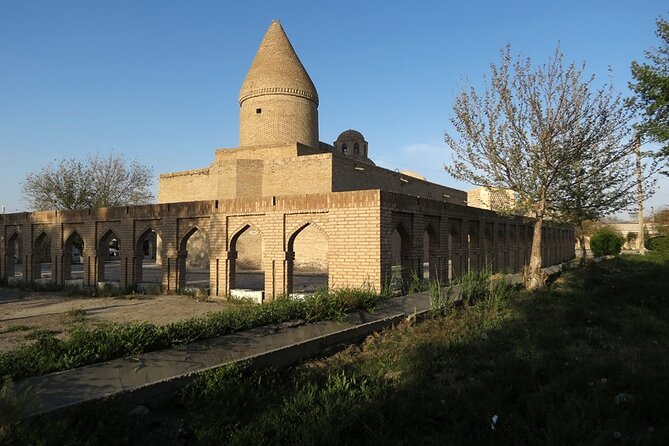
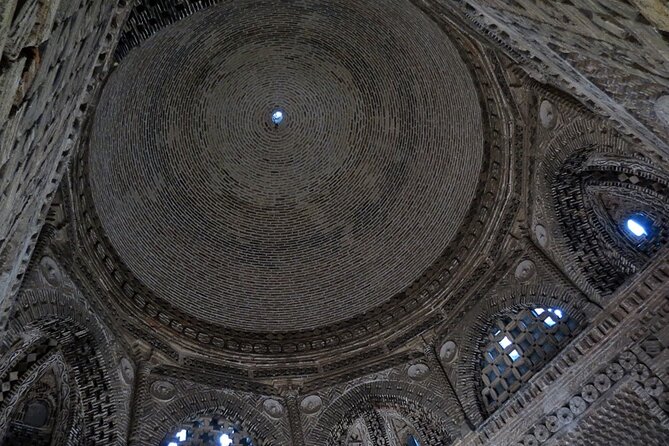
Finally, you reach Ismail Samani Mausoleum, which is the tour end point. This mausoleum is described as the first in Central Asia and the second in the Islamic world, and it is connected to the founder of the first local Emperor of Central Asia.
Ending here is a smart move. After hours of madrasas, mosques, and civic power sites, you land at a place that represents continuity and legacy. Mausoleums are often where the city’s identity becomes most condensed, because they’re built to outlast everything else.
If you still have time after the tour, linger a bit. Let the sense of early Central Asian Islamic style settle, especially if you enjoyed the story-driven approach earlier.
Price and logistics: what $28 gets you, and what to plan for
At $28 for a roughly 5 to 6 hour walking tour, this is solid value for a city like Bukhara where the main sites are spaced in a way that makes walking time efficient. You also get a professional guide and all fees and taxes included, plus a mobile ticket and group discounts depending on your booking details.
What is not included matters for your budget. Entrance to monuments specified in the program is not included, and lunch is not included either. So you should expect to pay extra if you want to go inside the stops that require tickets.
Also, air-conditioned vehicle is not included. That’s not a bad thing if you want to walk and see the old streets at human speed. Just go into it knowing it is a walking day.
Who this tour suits best
This is a great fit if you:
- have a half day to cover Bukhara’s top landmarks without building a route yourself
- want history explained in a clear way by guides who speak English, Spanish, French, German, or Russian
- like walking between major monuments while still getting at least one cultural detour, like the puppet theater stop
- prefer a route that mixes big architecture with city-life details, including trade spaces and quarters
It might be less ideal if you:
- are hoping for a fully ticket-included museum-style day
- need a lot of rest breaks, since it is designed as an all-in walking flow
- want transportation included, since there is no air-conditioned vehicle listed
Should you book the Bukhara Walking Tour?
Yes, if you want the fastest path to understanding Bukhara without missing the small, memorable extras. The mix of Lyabi Hauz, Poi Kalan, Ark, and Samanid Mausoleum gives you the major story beats, while the puppet theater history stop adds something you would not get from a plain monuments route.
If you can handle a walking half-day and you are okay paying separate entrance fees for certain sites, this tour is a smart booking at a friendly price. If not, you can still see much of Bukhara on your own, but you will likely miss the careful connections that make the city feel coherent.
FAQ
How long is the Bukhara Walking Tour?
The tour lasts about 5 to 6 hours.
Where does the tour start and end?
It starts at the Lyabi Khause ensemble Divan-Beghi area in Bukhara and ends at the Ismail Samani Mausoleum.
What is included in the price?
The price includes a professional guide (English, Spanish, French, German, or Russian) and all fees and taxes.
Are monument entrance fees included?
No. Entrance to the monuments specified in the program is not included.
Is lunch included?
No, lunch is not included.
Do I need an air-conditioned vehicle?
No vehicle with air-conditioning is included.
Is this a private tour or shared group?
It is private. Only your group participates.
What payment method is used for the ticket?
You receive a mobile ticket.
Can I cancel for a full refund?
Yes. You can cancel up to 24 hours in advance for a full refund. If you cancel less than 24 hours before the start time, it is not refunded.
Latest reviews out of Bukhara
- Uzbekistan 8 Days Private Guided Tour★ 4.6 · 3 reviews
- Bukhara: City Highlights Guided Tour with Pickup★ 5.0 · 3 reviews
- Bukhara day tour★ 4.0 · 4 reviews
- Bukhara Private City Tour★ 2.5 · 4 reviews
- Legends of Bukhara: Exclusive Full-Day Tour★ 5.0 · 4 reviews
- 2 Day Ukhum Hiking Tour from Bukhara★ 5.0 · 4 reviews
- From Bukhara: 3-Day Yurt Stay, Hiking & Lake Aydarkul★ 5.0 · 5 reviews
- Bukhara day tour. Departure from Tashkent or Samarkand.★ 5.0 · 7 reviews
Bukhara Tours, compared.
All You Need To Know About Bukhara. A Walk In The Town
Read our review →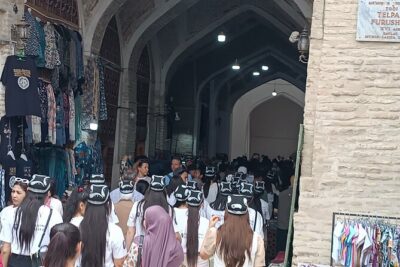
Browse the lists this tour appears in