
Reviewed · BUKHARA TOURS
Best of Bukhara: All Day Private Old Town Tour
Bukhara’s Old Town is interesting because the streets themselves feel like a timeline, and this all day private route ties the best monuments together in a way that actually makes sense. I love how you get up close to the Po-i-Kalyan skyline icons, and I love the chance to pause in the Trading Domes where the shopping feels old-school, not staged. A guide like Gulnaz or Shakhnoza can turn stone and tile into stories you’ll remember.
One thing to consider: many of the stops involve ticketed sites, so you should budget extra for entrances, not just the $65 tour price. This is also a walking day, so comfy shoes matter.
Key highlights worth your time
- Private guide, private pace with a local who can steer you through the why behind the what
- Po-i-Kalyan complex viewpoints for iconic photos of the Great Minaret area
- Ark of Bukhara fortress time to see how this city defended and ruled itself
- Trading Domes stop where “souvenirs” becomes a real market experience
- Madrasas with political history in their design like Ulugbek and Abdulaziz-Khan
- Bukhara Synagogue included for a rare look at shared neighborhood history
Why this Old Town walking route is so effective
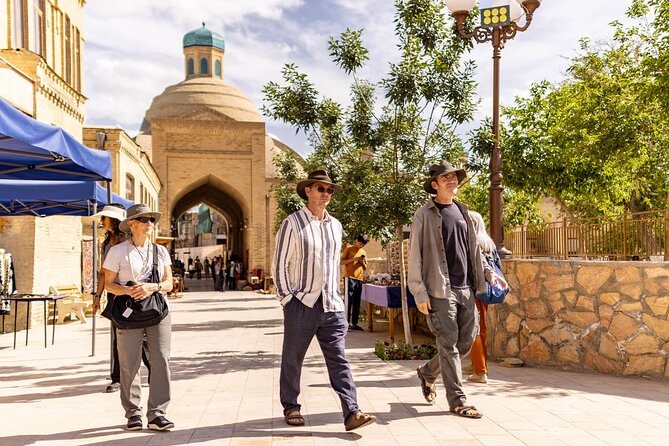
This tour is built for people who want to understand Bukhara in one long stretch, without bouncing around randomly. You cover a tight loop of the historic core, which is great because Bukhara’s best-known monuments are close enough to walk, but spaced enough that a guide’s route planning saves time and effort.
Expect about 5 to 7 hours on foot. That’s enough time to slow down for photos, get explanations while things are still fresh, and still see major highlights like the Ark of Bukhara and the madrasa cluster around the old square areas.
It also helps that you’re not doing this as part of a big group. It’s private, so you can ask questions in real time, linger when something grabs you, and move on when you want to keep the day flowing.
More of Bukhara worth pencilling in
- Best of Bukhara: All Day Private Old Town Tour
★ 4.9 · 62 reviews - Bukhara Full Day Old City Private Tour
★ 5.0 · 46 reviews - Legends of Bukhara: Exclusive Full-Day Tour
★ 5.0 · 4 reviews
Price and logistics, what it really means for your budget
The tour costs $65.00 per person and includes a private tour, hotel pickup (guide meets you at a central hotel), and a professional local guide. You also get photo opportunities and a mobile ticket, which is practical if you do not want to deal with paper.
What you may pay extra is where the value math gets real. The tour lists an entrance fee for museum and historical sites of $6.00 per person. Some parts of the day are marked as free or included, while others are not.
Here’s the practical way to think about it:
- If you’re interested in monuments beyond looking at them from the outside, you should plan to pay that extra $6.
- If you prefer mostly exterior views, you might feel the extra cost less, but you’ll still want at least some interior moments, especially at the madrassas.
Also note that this is a walking tour with a lot of stops. Even if the duration is “only” half a day in some schedules, you’ll still be covering significant ground. Bring water, wear shoes you trust, and keep your camera ready.
Lyab-i Hauz, the pond square, and the first sense of Bukhara
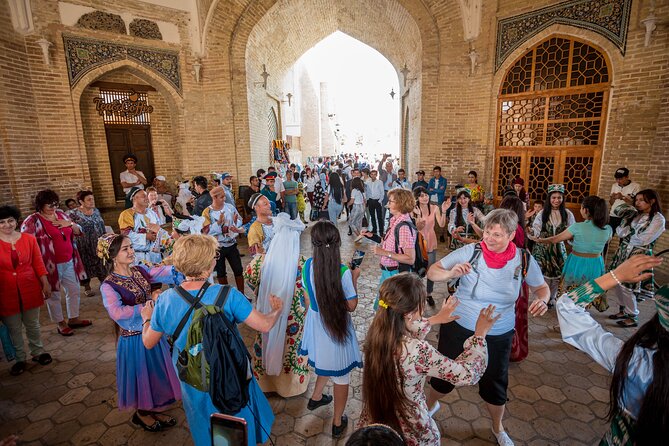
You start at Lyab-i Hauz, a central square in the southeast part of the city. The name means at the pond, and the layout gives you that classic Bukhara feeling of a shared public space, with architecture built to frame everyday life.
This stop is free and short, around 30 minutes. Don’t treat it as a quick check-in. Use it as your mental warm-up. Once you understand Lyab-i Hauz as a hub, the rest of the Old Town makes more sense, because many of the religious and educational buildings connect back to how people once gathered, traded, and studied.
Po-i-Kalyan and the Great Minaret zone for skyline photos
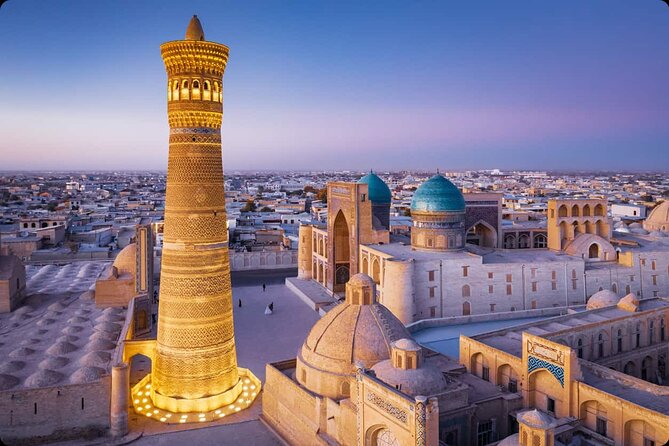
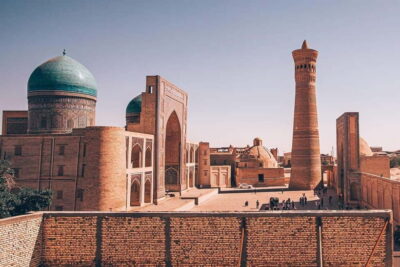
Next you head to the Great Minaret of the Kalon. This is a big landmark for a reason. The Kalyan minaret belongs to the Po-i-Kalyan mosque complex, and it’s one of the most prominent vertical features in the Old Town skyline.
Plan about 30 minutes here. This is not just a photo stop, though. A good guide will point out how the minaret and mosque complex work together visually, so the architecture reads as a single idea rather than separate buildings. The minaret stop is marked as not included for admission.
An easier afternoon once Bukhara is done:
- Bukhara: Walking Tour with a Small Group
★ 4.9 · 260 reviews - From Bukhara: 2-Day Desert Yurt Camp Tour
★ 4.5 · 57 reviews - City Tour Around Bukhara
★ 5.0 · 55 reviews - Bukhara: Historic Center Guided Sightseeing Tour
★ 4.8 · 44 reviews
Mir-i-Arab Madrasa and why it matters beyond the tiles
After that you’ll see Mir-i-Arab Madrasa. This is one of those stops that can feel like a building with a brochure label, until you get the human context. It was the only spiritual educational establishment in the USSR that continued functioning after WWII, and leading imams from those times graduated from this center.
You get about 20 minutes. The value here is not just design details, but understanding how religious education survived and restarted through major political changes. The admission is not included, so if you’re paying attention to interiors, budget that extra.
Poi Kalyan Mosque complex, where the pieces connect
Then you move into Poi Kalyan Mosque (also called Po-i-Kalan). The complex includes three major elements: the Kalan Mosque, the Kalan Minaret (the landmark you just saw), and the Mir-i-Arab Madrasah.
The stop is around 30 minutes and admission is not included. This is a good moment to ask your guide to explain how each part’s purpose differs. When you understand that, the complex becomes more than a scenic cluster. It becomes a system for worship, teaching, and public identity.
Bolo Hauz Mosque, built in 1712, and the UNESCO connection
You next visit Bolo Hauz Mosque, built in 1712. It sits opposite the Ark of Bukhara in the Registan district, which means it naturally anchors you in the bigger story of power, faith, and daily movement inside the walled city.
You’ll spend about 10 minutes. Admission is marked as not included, but the site is described as part of the UNESCO World Heritage listing with other parts of the historic complex.
This short stop works best if you treat it like a pause between big-ticket sights. Look across the area from where your guide places you, so you can picture how the city’s major structures faced each other.
Ark of Bukhara, the fortress that controlled the city
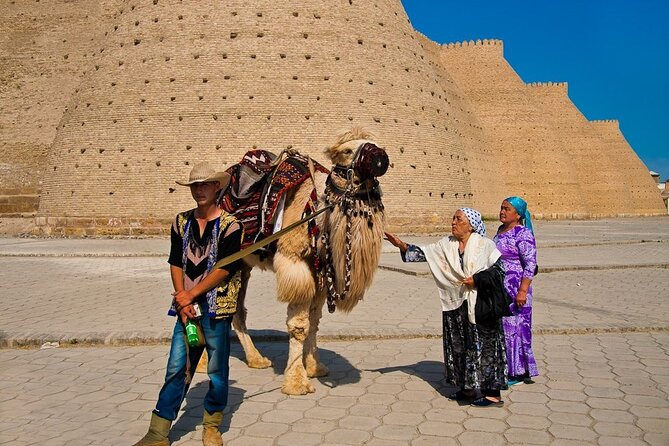
Now you’ll hit the core power symbol, the Ark of Bukhara. This is a massive fortress first built and occupied around the 5th century AD. Even if you’ve never studied Central Asian dynasties, the Ark’s scale gives you a quick sense of authority.
The tour allocates about 1 hour at the Ark, and admission is not included. This is one of the best places to slow your pace and let the guide explain the timeline. Your guide can help you connect why a fortress like this mattered, not just that it existed.
One practical consideration: places like the Ark can involve uneven ground and steps. If mobility is an issue, keep your guide in the loop early. In past cases, guides adjusted pace for people who could not move fast up and down stairs.
Trading Domes, souvenirs that feel like real commerce
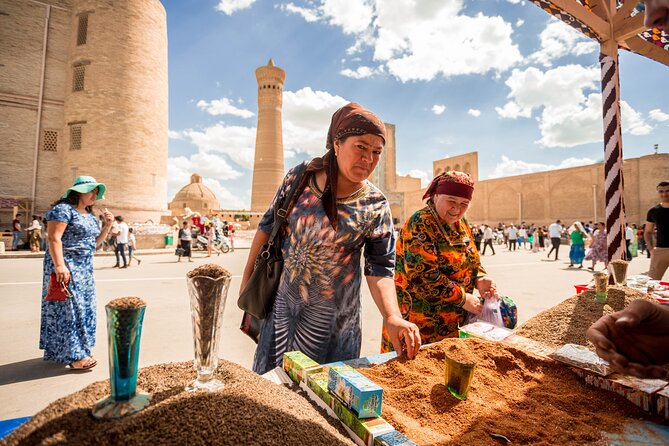
After the fortress, the day shifts from power to trade with Trading Domes. There are four trading domes remaining in the ancient city, lined up on a north to south route through the Old Town.
The stop is about 30 minutes, and admission is free. This part is especially good if you want the practical side of Bukhara, since the domes connect to the city’s role along trading routes. The tour frames it as a place to find carpets, Uzbek spices, and the kind of shopping where you can actually watch how stalls and trade spaces work.
If you like to buy souvenirs, this is where you’ll probably get the best inspiration. If you do not plan to buy much, you can still use this stop to understand what Bukhara sellers valued, what locals likely carried daily, and how markets shaped street life.
Nodir Devon Begi Madrasasi, a former caravanserai turned school
Now you move to Nodir Devon Begi Madrasasi, built in 1622 and 1623 by the vizier of Imamkuli-khan. The important twist is that it began as a caravanserai, then later became a madrasah.
You get about 20 minutes, and admission is not included. This stop is one of the best reminders that these buildings did not always have one job. The city repurposed structures as needs changed, and your guide can help you see how “travel and commerce” and “learning and religion” overlap here.
It’s also a good place to ask how lodging worked for people arriving from the Silk Road and other trade routes. Even a simple explanation can make the surrounding streets feel less like scenery and more like a route.
Hodja Nasreddin monument and a rare breath of humor
You then stop at the Monument to Hodja Nasreddin. It’s a bronze monument located beside the Lyab-i Hauz complex, installed in 1979.
This stop is about 20 minutes, and admission is listed as included. It sounds like a side stop, but it matters because it humanizes the city. You’ll see how Bukhara also remembers jokes, folk character, and everyday wisdom, not only emperors and monuments.
It’s a good reset point before you continue deeper into the madrasa and religious complex areas.
Maghoki Attori Mosque, tied to the Lyab-i Hauz religious complex
Next up is Maghoki Attori Mosque, part of the historical religious complex of Lyab-i Hauz. The tour gives you around 30 minutes, and admission is not included.
This is often the kind of stop where a guide’s explanation makes a difference. You might notice details quickly, but it’s the connection to the larger Lyab-i Hauz religious layout that makes the architecture feel purposeful.
Ulugbek Madrasah and its exterior tilework
Now you’ll visit Ulugbek Madrasah, completed in 1420. The highlights here include exterior tiles, a fluted dome, stained windows, and old tombs. The stop is about 30 minutes, with admission not included.
Even if you do not spend long inside, this is a strong visual stop because the building design is described in very specific ways. Ask your guide what stands out and why, and you’ll likely come away with a mental map of how Ulugbek’s era tried to project learning and prestige.
Abdulaziz-Khan Madrasah and the science-minded patron angle
You then see Abdulaziz-Khan Madrasah. The tour notes that Ulughbek was famous as a scholar and patron of the sciences, and it mentions Abdulaziz-Khan Madrasah in that tradition. It also states his first madrasa was built in 1417 in Bukhara.
You’ll have about 30 minutes, and admission is not included.
This is another stop where it helps to listen for the purpose behind the design. A madrasa is not only a place to study, it’s a statement about who funds learning and how that learning is meant to be respected.
Bukhara Synagogue, Jewish worship in a shared neighborhood story
Finally, you visit the Bukhara Synagogue. This is a holy place of worship in the Jewish religion. The tour info also points out that before its construction, Jews of Bukhara prayed together with Muslims in the same mosque.
You get about 20 minutes, and admission is not included.
This stop is meaningful because it widens the story of Bukhara beyond a single religious lane. When you understand that shared space existed in the past, the whole Old Town feels more human and less one-dimensional. It’s also a reminder that history in Bukhara was shaped by communities living side by side.
How to get the best day from your private guide
A private tour only works well if the guide knows how to explain. Based on the guide styles you’ll encounter, the strongest days tend to feature good English, a friendly manner, and answers that connect architecture to daily life.
If you can, choose a guide who will:
- adjust pacing when someone needs a slower route (I’ve seen this happen in real situations)
- answer questions about crafts and markets, not only monuments
- share practical tips after the tour for what to eat and where to buy
Because the itinerary is packed with major sites, your best strategy is to decide what you care about most before you meet your guide. If you’re here for crafts, tell them early and ask if you can add time around local artisan activity. If you’re here for architecture, ask for the differences between the minaret complex and the madrasas. If you’re here for history, ask how the city’s rulers shaped public space and learning.
Also, take photos but do not let your camera run the day. Pause, listen, then shoot.
Should you book this Best of Bukhara Old Town tour?
I think this is a smart booking if you want an organized walk through Bukhara’s most recognizable Old Town anchors, and you want a local guide to connect what you see with why it exists. At $65 per person, the private format and hotel pickup make it feel efficient, especially when you add up the time you would spend trying to map the route alone.
Skip or rethink it if:
- you hate walking and stairs, because this is a long day on foot
- you are not interested in ticketed entrances, since many major stops are marked as not included and you should budget that extra $6 per person for museum and historical sites
If you want a one day orientation that still feels personal, this tour is a strong fit. And if your plans shift, the experience offers free cancellation up to 24 hours before the start time.
FAQ
How long is the private Old Town tour in Bukhara?
The tour duration is listed as 5 to 7 hours (approx.).
Is hotel pickup included?
Yes. The guide meets you at central hotels.
Is this tour private?
Yes. It is a private tour, so only your group participates.
What entrance fees should I expect to pay separately?
The tour indicates an entrance fee for museum and historical sites of $6.00 per person. Many specific stops are marked as not included, while some are free or included.
Are any stops free or included without extra tickets?
Yes. Lyab-i Hauz and Trading Domes are marked as admission free, and the Monument to Hodja Nasreddin is marked as admission included.
Do I need paper tickets?
No. You get a mobile ticket.
What is the cancellation policy?
There is free cancellation up to 24 hours in advance for a full refund.
Latest reviews out of Bukhara
- Uzbekistan 8 Days Private Guided Tour★ 4.6 · 3 reviews
- Bukhara: City Highlights Guided Tour with Pickup★ 5.0 · 3 reviews
- Bukhara day tour★ 4.0 · 4 reviews
- Legends of Bukhara: Exclusive Full-Day Tour★ 5.0 · 4 reviews
- Bukhara Private City Tour★ 2.5 · 4 reviews
- 2 Day Ukhum Hiking Tour from Bukhara★ 5.0 · 4 reviews
- From Bukhara: 3-Day Yurt Stay, Hiking & Lake Aydarkul★ 5.0 · 5 reviews
- Bukhara day tour. Departure from Tashkent or Samarkand.★ 5.0 · 7 reviews
Bukhara Tours, compared.
All You Need To Know About Bukhara. A Walk In The Town
Read our review →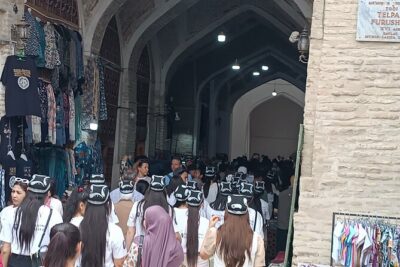
Bukhara Historical City Highlights Guided Walking Tour
Read our review →Browse the lists this tour appears in