
Bukhara’s Old Town can feel like a living set, with domes, minarets, and courtyards stacked so close together you keep turning corners and finding another famous view. This Legends of Bukhara full-day style tour is built for exactly that, a concentrated route that mixes the headline sights with smaller stops that give the city its texture.
I especially like two things here: the professional local guide who can answer questions as you walk, and the way the route pairs big architecture (like the Kalyan Minaret and Po-i-Kalyan complex) with everyday craft and commerce, including a blacksmith workshop stop. That combination makes the day feel more real, not just postcard hopping.
One drawback to consider is simple: you are on your feet for 5 to 8 hours, and the tour also notes a $6 per person entrance fee for museum and historical sites, plus lunch and tips are not included. If you want a totally free, no-added-cost wandering day, this may feel a bit pricier than doing it DIY.
Key highlights before you go
- A UNESCO Old Town walking circuit that links the city’s most recognizable monuments with lesser stops
- Lyab-i Hauz as the start point: a pond-centered square dating to the 16th and 17th centuries
- Kalyan Minaret and Po-i-Kalyan complex: Bukhara’s skyline views and major religious architecture
- Madrasas with strong stories: Mir-i-Arab, Ulugbek, Abdulaziz-Khan, and Nodir Devon-Begi
- Hands-on feel at the blacksmith workshop: traditional crafts and tools, not just stone
- A day that keeps mixing faith and culture: mosques, mausoleums, a synagogue stop, and a Hodja Nasreddin monument
The flow of the day: how this walking route stays manageable
This is a guided Old Town loop in Bukhara, and the pacing is designed around short visits. Most stops are listed at about 30 minutes each, so you get time to look, take photos, and still keep moving without feeling stuck at a single building.
Pickup is offered, which matters in Bukhara, because the Old Town streets are not the kind you want to negotiate before you have your bearings. Also, this is a private tour/activity for your group (if you select that option), so you are not competing with a larger crowd for the guide’s attention.
A smart expectation: you can plan for a morning to early afternoon rhythm. One reported schedule ran from about 8:00am to 12:15pm, and that fits the idea that your timing can land on the shorter side if your group moves quickly and sites are accessible.
More of Bukhara worth pencilling in
- Best of Bukhara: All Day Private Old Town Tour
★ 5.0 · 66 reviews - Best of Bukhara: All Day Private Old Town Tour
★ 4.9 · 62 reviews - Bukhara Full Day Old City Private Tour
★ 5.0 · 46 reviews
What to wear and bring for Old Town walking
You will thank yourself for good shoes. Even when the route is “only” a few kilometers, cobbles and tight lanes add up fast.
Bring water, sun protection, and a light layer. Your guide will be outside a lot, and even in pleasant weather you can feel the walk in the arms and legs.
Lyab-i Hauz: the pond square that sets the tone
The tour starts at Lyab-i Hauz, meaning at the pond, and that translation is not just poetic. This is the kind of central square where the space is organized around water and the buildings lean into it, so you get a natural place to orient yourself.
Architectural planning here traces back to the 16th and 17th centuries, so you are standing in the heart of how Bukhara staged daily life. Expect a classic “watch people while you look around” moment, with easy photo opportunities and a calm base before you head into bigger monuments.
If you’re arriving fresh, this stop is a win because it helps you understand the city’s layout fast. After you’ve seen Lyab-i Hauz, later landmarks make more sense as parts of one connected Old Town system rather than random stops.
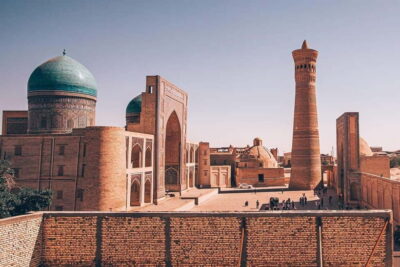
Kalyan Minaret and Po-i-Kalyan: Bukhara’s most famous skyline angle
Next comes the Great Minaret of Kalon, also tied to the Po-i-Kalyan mosque complex. The Kalyan Minaret is one of Bukhara’s best-known landmarks, and even if you have seen photos before, seeing it in person tends to make you pause.
This is a “look up” stop. Up close, the tower’s scale hits differently because your brain stops comparing it to other minarets and starts measuring it against the lane widths and neighboring domes.
You then move to the wider Po-i-Kalyan complex, which includes the Kalan Mosque, the Kalan Minaret, and the Mir-i-Arab Madrasah. The point here is not just architecture. It is the idea of a religious and educational hub built as one visual and functional unit, where learning and worship are part of the same street-level story.
An easier afternoon once Bukhara is done:
- Bukhara: Walking Tour with a Small Group
★ 4.9 · 260 reviews - From Bukhara: 2-Day Desert Yurt Camp Tour
★ 4.5 · 57 reviews - City Tour Around Bukhara
★ 5.0 · 55 reviews - Bukhara: Historic Center Guided Sightseeing Tour
★ 4.8 · 44 reviews
Mir-i-Arab Madrasa: an educational site with modern-era resonance
At Mir-i-Arab Madrasasa, the key detail is that it was the only spiritual educational establishment in the USSR that had begun to function after WWII. That is a striking piece of context, because it links this place to a 20th-century timeline, not only ancient or medieval eras.
If you care about how traditions survive political pressure, this stop adds real weight. Even if you do not read a single inscription, the guide can help you connect the purpose of the building to the larger resilience story.
Bolo Hauz Mosque and the Registan side of the Old Town
The tour includes Bolo Hauz Mosque, built in 1712. It sits on the opposite side of the Ark area in the Registan district, which gives you another helpful perspective on how Bukhara’s monuments are distributed.
This stop is a good break from chasing the tallest structures. It shifts your attention from minarets and skylines to the way mosques occupy space, with a sense of geometry that feels practical rather than theatrical.
Because the tour keeps visits around half an hour, Bolo Hauz works best if you treat it like a reset moment. Take a breath, re-check your route in your head, then get back into the flow.
Ark of Bukhara: power, age, and the city’s original center
When you reach the Ark of Bukhara, you are stepping into the site that functioned as a fortress of power. It is described as initially built and occupied around the 5th century AD, so this is one of those locations where the time depth feels immediate.
The Ark is also a useful stop for your mental map. After you’ve seen religious complexes and madrasas, Ark gives you the secular authority angle, the “who ruled and controlled” piece of the puzzle.
Practical tip: if you like details, spend a few extra seconds looking at how the fortress walls relate to the streets you just walked. The Old Town layout is not random, and Ark is a big reason.
The madrasas: Ulugbek, Abdulaziz-Khan, and why tiles matter
This tour does not treat madrasas as just “another historic building.” It threads them through the day so the educational theme builds.
You visit Ulugbek Madrasah, completed in 1420, and the description focuses on exterior tilework, a fluted dome, stained windows, and old tombs. Even if you only catch a glimpse, these are exactly the kinds of visual cues that help you understand why madrasa architecture was designed to teach by beauty as much as by text.
Then comes Abdulaziz-Khan Madrasah, tied to scholarship and sciences. The guide context here is that Ulughbek was famous both as a ruler and as a patron of the sciences, and his first madrasa in Bukhara is linked to 1417. That matters, because it frames these buildings as institutions of knowledge, not just religious ornament.
Nodir Devon-Begi Madrasasi: a caravanserai turned school
You also stop at Nodir Devon-Begi Madrasasi, built in 1622-1623 by the vizier of Imamkuli-khan. The important twist is that it ran as a caravanserai first, then later converted into a madrasah.
That one detail is a reminder that Bukhara’s “learning” was connected to travel, trade, and the movement of people. It helps you picture the Silk Road not as an idea, but as daily logistics, with buildings repurposed as needs changed.
Blacksmith workshop and craft tools: the Silk Road in your hands
One of the most rewarding parts of the day is the blacksmith workshop stop. This is described as part of a museum-preserve effort to revive and support traditional Bukharan handicrafts.
You will see tools and materials connected to metalwork, including swords, knives, arrowheads, and craftsmen’s instruments. Even if you do not buy anything, the value is in watching how craft is displayed and explained, because it connects the monument-heavy day to human work.
This stop also helps if you get “museum fatigue.” It is still cultural, still historical, but it feels more grounded. Your brain gets a break from tile and calligraphy and returns to practical making.
Trading Domes: where goods flow through narrow streets
The tour includes the Trading Domes, noting that four remain in the ancient city along a north to south route. This is a smart inclusion because it shifts you away from only religious or political power and into everyday commerce.
You are not meant to treat domes as a standalone “see it and leave” item. Instead, it’s a chance to understand how Bukhara’s traders shaped movement through the city, channeling people along consistent corridors.
If you like architecture but also care about how cities function, this is the stop where your interest probably clicks.
Chor Minor: a gatehouse reminder of what used to be
At Chor Minor, you are looking at a historic gatehouse for a now-destroyed madrasa. It is located in a lane northeast of the Lyab-i Hauz complex and is also known as the Madrasah of Khalif Niyaz-kul.
This stop is valuable because it shows you that even destruction becomes part of the story. You’re not only viewing what survives. You’re also understanding what was lost, and why gatehouses can still carry meaning even when the main building is gone.
It also gives you variety in shapes. The day has big, tall monuments and long complex façades. Chor Minor helps you notice smaller architectural rhythm.
The Hodja Nasreddin monument and the human side of Bukhara
Next you come to the Monument to Hodja Nasreddin, a bronze statue located beside the Lyabi-Hauz complex in the central square. It was installed in 1979, and the description highlights the air of joy and humor.
That matters because it is the cultural counterweight to stone seriousness. After temples, tombs, and fortresses, a playful public figure stop reminds you that Bukhara also preserves humor, folklore, and everyday storytelling.
This is also an easy win for photos, especially since the location is tied to the same core area you started from.
Bukhara’s synagogue stop: a different kind of religious architecture
The tour includes a stop at Bukhara Synagogue, described as a holy place of worship in the Jewish religion. The context given is that before the synagogue was constructed, Jews of Bukhara prayed together with Muslims in the same mosque.
You might not think of this as a “Silk Road city detail” until you see it. This stop broadens your sense of how religious life overlapped in different periods. It is also a good reminder that Old Town Bukhara was not only Islamic institutions, even if Islamic architecture dominates the skyline.
Ismail Samani Mausoleum: closing with a 10th-century landmark
Your last major anchor stop is the Ismail Samani Mausoleum, a mausoleum built in the 10th century CE as the resting place of a powerful and influential Samanid ruler. It is located just outside the historic center, in the northwestern part of Bukhara.
This is a nice end point because it gives you time depth right away, without needing to interpret a long complex courtyard. Mausoleums often feel more compressed, so in a few minutes you can grasp the significance.
If the earlier stops made you feel like you were walking through layers of religious and educational life, this one brings in political legacy and dynastic memory.
Price and value: what you are really paying for
The tour price is $35.00 per person, and the day typically runs 5 to 8 hours. It is booked on average about 36 days in advance, which is a hint that people plan ahead for this type of structured Old Town experience.
What you get is a professional local guide, pickup offered, photography opportunities, and group discount options. The big practical piece is the $6 per person entrance fee for museum and historical sites, which is not included in the base price.
So yes, it costs money beyond the sticker price. But you’re paying for time and order: a route that hits major monuments in an efficient sequence and a guide who can explain what you are looking at as you walk, especially in stops like Mir-i-Arab Madrasa where the USSR-era detail adds meaning.
Lunch and tips are not included. Plan to grab something simple on your own after the tour, and budget a bit for tips if your guide does a great job. If you skip lunch planning entirely, you can end up hungry at the exact moment you want to keep exploring.
Small practical tips that make this tour smoother
Here’s how to get more out of every stop without slowing down.
- Wear shoes you trust. This is an Old Town walking day, and cobblestones do not care about fashion.
- Take advantage of the guide’s stop-by-stop explanations. The listed stops are short, so ask your questions while you’re there, not later.
- Bring cash or be prepared to pay the stated $6 entrance fee for museum and historical sites.
- For photos, time your shots. Many stops are outdoor or semi-outdoor, but shaded areas and moving crowds can change your angles quickly.
- If it is hot, treat the shade and courtyard moments as your schedule. Don’t fight the sun with stubborn persistence.
Who should book this tour, and who might prefer DIY
This tour is a strong fit if you’re a first-time visitor to Bukhara and you want a guided walk that covers the core landmarks without you building a route from scratch.
It’s also ideal if you like context. The itinerary descriptions include very specific backstory, like Mir-i-Arab Madrasa’s WWII-era functioning in the USSR and Nodir Devon-Begi’s conversion from caravanserai to madrasah. A guide makes those details land, instead of feeling like random facts.
You might choose a different approach if you already know Bukhara well, or if you prefer unstructured wandering with no set stop order. With 30-minute segments, this is not a slow “stare at every tile for an hour” kind of day.
Should you book Legends of Bukhara?
If you want a well-paced Old Town experience that hits the must-see monuments and also includes craft and human-scale cultural stops, I think this is a good booking. The pricing makes the most sense when you value a guided route, short explanatory stops, and efficient sightseeing across major sites like Lyab-i Hauz, Po-i-Kalyan, Ark, and Ismail Samani Mausoleum.
Book it if you’re willing to walk and you’re okay budgeting for the listed entrance fee plus your own lunch. Skip it if you want zero extra costs beyond transit, or if you get stressed by having a schedule during a historic city walk.
If you decide to go, do yourself a favor and start the day with water and comfortable shoes. Then let the guide do the heavy lifting on context, while you do what you came for, looking up, looking around, and actually seeing how Bukhara hangs together.
FAQ
How long is the Legends of Bukhara tour?
The duration is listed as about 5 to 8 hours.
Is pickup included?
Pickup is offered.
Are entrance fees included in the price?
No. Entrance fees for museum and historical sites are listed as $6 per person and are not included.
What is included with the tour?
Included features are a professional local guide, a private tour if that option is selected, and photography opportunities.
Is lunch included?
No, lunch is not included.
Is the tour suitable for walking?
The tour requires moderate physical fitness.
What is the cancellation policy?
Free cancellation is available up to 24 hours in advance for a full refund. The experience requires good weather, and if it is canceled due to poor weather, you are offered a different date or a full refund.
Latest reviews out of Bukhara
- Uzbekistan 8 Days Private Guided Tour★ 4.6 · 3 reviews
- Bukhara: City Highlights Guided Tour with Pickup★ 5.0 · 3 reviews
- Bukhara day tour★ 4.0 · 4 reviews
- Bukhara Private City Tour★ 2.5 · 4 reviews
- 2 Day Ukhum Hiking Tour from Bukhara★ 5.0 · 4 reviews
- From Bukhara: 3-Day Yurt Stay, Hiking & Lake Aydarkul★ 5.0 · 5 reviews
- Bukhara day tour. Departure from Tashkent or Samarkand.★ 5.0 · 7 reviews
- Bukhara in a Day History, Culture, and Local Insight Private Tour★ 5.0 · 4 reviews
Bukhara Tours, compared.
All You Need To Know About Bukhara. A Walk In The Town
Read our review →
Browse the lists this tour appears in