
Bukhara works like an open-air textbook, and this walking tour is a smart way to read it without getting lost. You cover the city’s big UNESCO-area landmarks on foot, with time to pause, ask questions, and make sense of what you’re seeing.
I especially love the professional, English-speaking guide who keeps the stories moving, and the way the route strings together key places like Lyabi-Hauz and the Poi-Kalyan Ensemble so the old city feels connected, not random. I’ve also noticed guides in this program often personalize the pace, so even when the group is small, you do not feel rushed.
One possible drawback is that it is not a shopping-focused tour, so if you’re hoping for long bazaar wander-and-buy time, you may find the artisan stops a bit short. Also, it is a walking tour, so wear comfortable shoes and be ready for uneven old-town streets.
Key things you’ll like on this Bukhara walking tour

- Professional English guides (not students or trainees), often with a relaxed, interactive style
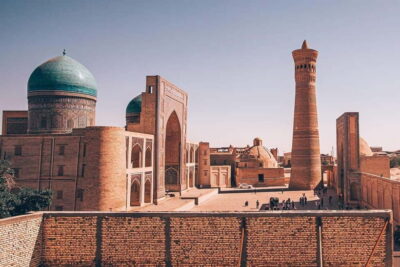
- Poi-Kalyan Ensemble centerpiece with Kalyan Minaret and Kalyan Mosque, plus Miri Arab Madrasah across the square
- Trading-domes circuit that explains how money, crafts, and daily commerce shaped the city
- Madrassahs with readable details, including Ulugbek and Abdulazizkhan Madrasahs
- Artisan workshops, not a hard sell, plus optional local masterclasses with no payment expected for the visits
- A finish at the big names in Bukhara like Bolo-Hauz, Chashma-Ayyub, and the Ismail Samani Mausoleum
Entering Bukhara from Nodir Devonbegi Madrasa to Lyabi-Hauz Square

Your tour starts at the meeting point at the Nodir Devonbegi Madrasa entrance gate, and you’ll meet your guide about 5 minutes early. From there, you ease into the old-city rhythm fast, which matters in Bukhara. The lanes can look similar, and the quickest way to get oriented is to have someone point out what changed over time and why each place matters.
The first major stop is Lyabi-Hauz Ensemble, the heart of old Bukhara’s public life. This is the kind of spot where a pool, madrasahs, and a khanaka sit close together, so you can feel how education, religion, and neighborhood life overlap. Your guide typically helps you notice the small architectural logic, like where the sightlines hit and why this area became a natural meeting point.
Lyabi-Hauz is also a great place for the tour’s pacing to click. Several guides in the program are praised for keeping things interactive, and you usually get enough context early on that the rest of the day starts to feel like a coherent story.
More Walking Tours in Bukhara
- All You Need To Know About Bukhara. A Walk In The Town
★ 4.9 · 31 reviews - Bukhara Walking Tour
★ 4.7 · 25 reviews - Bukhara Historical City Highlights Guided Walking Tour
★ 4.5 · 16 reviews
Sayfuddin Caravanserai and Toki Sarrafon: how trade shaped the city

After Lyabi-Hauz, you move toward older commercial infrastructure, starting with Sayfuddin Caravanserai. Caravanserais can feel like “just a building” if you’re not told what to look for, but on this walk you get the purpose: these were compact stops for travelers and merchants. Think of it as logistics in stone, with a human scale that still reads well today.
Next comes Toki Sarrafon, an old trading dome once linked with money changers. This is where the tour becomes more than sightseeing. Trading domes like this show you that Bukhara’s fame was not only about scholars and mosques. It was also about finance, routes, and the everyday work that kept caravans moving.
If you like history that feels practical, this segment is for you. Guides such as Shamsidonov Dilshod and Mari are described as the kind of people who explain details so they click, not so you just memorize facts. You’ll probably find yourself looking up at the dome structure and down at the space people used to occupy, which is a big part of why the city reads so well in a walking format.
Magoki-Attori Mosque and the Carpet Museum stop

Then you head to Magoki-Attori Mosque, one of the older mosques in Bukhara. The special touch here is that it now connects to the Carpet Museum. Even if you are not a museum person, this stop can help you understand a key reality about the region: art and craft were never separated from religious spaces and civic life.
The mosque is also a good “mental reset” during the tour. After domes and caravan architecture, you’ll shift to a different kind of design language, with the focus more on religious function and communal gathering. And because the tour is capped at a small group size, you’re not pushed through in a blur.
A practical note: you’ll want to dress modestly for mosque visits. If you forget, you might end up making quick adjustments on the spot, and nobody wants that. Bring something simple to cover shoulders or knees if you’re traveling light.
Telpakfurushon and Zargaron domes: Bukhara’s covered bazaars

The tour then leans deeper into covered bazaar life. Toki Telpakfurushon is the largest covered bazaar, historically a hub for hat and skullcap sellers. This is a reminder that the old city’s commerce was not abstract. It was tactile, personal, and tied to clothing and identity.
After that, you see Abdullakhan Tim, an elegant domed bazaar built for silk trading. If you’ve ever wondered why domes keep showing up in Bukhara, this is your clue. Covered spaces protected goods, controlled conditions, and created indoor social flow. In other words, the architecture helped trade happen.
Finally, Toki Zargaron brings you to a dome where jewelers once worked and sold crafts. This is the point where the walking tour becomes a craft-oriented cultural lesson, without becoming a shopping trip. Many guides, including Guli and Sunny (as mentioned in the program), are praised for taking people to artisan demonstrations in a way that feels educational rather than sales-driven.
You can walk these bazaar stops with your camera, but also keep your eyes on the details you might miss alone: doorway rhythms, workshop-style spaces, and the way crowds would have moved under the domes.
More of Bukhara worth pencilling in
- Bukhara: Private Guided Walking Tour with Hotel Pickup
★ 5.0 · 11 reviews - Bukhara: Walking Tour with a Small Group
★ 5.0 · 10 reviews - A Group Walking Tour Of Old Town
★ 5.0 · 8 reviews - Bukhara Walking Tour
★ 5.0 · 4 reviews
Ulugbek and Abdulazizkhan Madrasahs: reading the architecture like a map

Next up are two major madrassah visits that help you understand Bukhara’s long thread of Islamic education. Abdulazizkhan Madrasah is decorated with colorful mosaics and carved details. Ulugbek Madrasah is one of the city’s oldest Islamic schools, built by the astronomer Ulugbek.
This is where a strong guide changes everything. Without context, madrassahs can look like ornate walls. With context, you start seeing how education, science, and art overlap. Ulugbek’s connection to astronomy gives you a lens beyond decoration, and it tends to make the details feel intentional rather than random beauty.
Guides like Khurshida and Khurshide are noted for being patient, interactive, and able to answer lots of questions. That matters here. If you ask about the symbolism, you usually get a clear explanation that helps you connect what you see to how people lived.
One more practical tip: plan for indoor lighting differences. Some mosaic areas photograph better when you angle your phone or camera slightly. Move slowly, and don’t block other visitors while you shoot.
Kalyan Minaret, Kalyan Mosque, and Mir-i-Arab Madrasa in one big UNESCO-feeling square

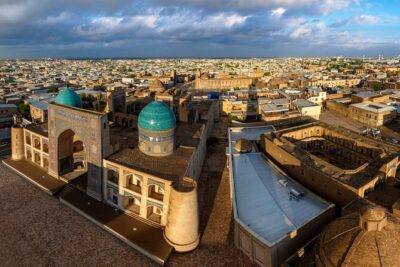
Your walk reaches the Poi-Kalyan Ensemble heart, which is often what draws people to Bukhara in the first place. You’ll see the iconic Kalyan Minaret, a 12th-century tower that acts like a landmark compass in the old city.
Then comes Kalyan Mosque, a massive Friday mosque with capacity for around 10,000 worshippers. That number sounds huge, but the building’s scale makes it easy to visualize crowds. Your guide typically helps you understand how Friday congregations shaped urban life, not only religious practice.
Opposite sits Miri Arab Madrasah, an active Islamic school. One of the best parts of a small-group walk is you can stand in the right spot to understand the layout of the entire complex. You don’t just “see” the structures. You get a sense of how they relate across open space.
This area also tends to be where the guides are most animated, because it’s the most photogenic and the easiest to explain. Even if you’re not into big monumental stops, the Kalyan square is worth your time because it’s Bukhara’s visual shorthand for power, faith, and community.
Ark Fortress outside views: a city of rulers seen from the edges

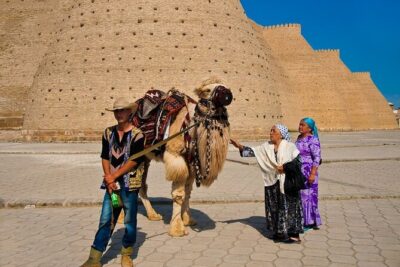
The Ark Fortress is passed by for outside views. This is the ancient citadel of Bukhara’s rulers, now used as the Bukhara State Museum. The key point is that you will not do a full museum walkthrough because it would add 1 to 1.5 hours.
That’s a real consideration for your day. The tour is built to fit in a half-day window, so you get the important structural context without sacrificing the rest of the highlights. You still see what you need: the fortress presence, the scale, and how it dominates the area.
If your main goal is to understand Bukhara as a functioning old city, outside views work well. A full museum visit is great too, but it becomes a different kind of tour. Here you keep moving and keep the storyline tight.
Bolo-Hauz and Chashma-Ayyub: where legends and reflection meet

The next stop is Bolo-Hauz Mosque, famous for its wooden pillars reflected in the pool. This is one of those places where the atmosphere matters as much as the architecture. When you see the reflection effect, the mosque stops being an abstract monument and becomes a visual scene.
After that, you visit Chashma-Ayyub Mausoleum, tied to the legend of Prophet Job, with Job’s Spring. You can think of this as a spiritual geography stop. It’s not only about what the building looks like, it’s about why people traveled to water, stories, and sacred sites.
This is also often where the tour feels most human. The legends give you a reason to care about a location beyond dates and dynasties. And if your guide is the kind who tells stories clearly, the whole day starts feeling less like a checklist and more like a guided walk with meaning.
The Ismail Samani Mausoleum finish: a 10th-century anchor

You end with the Ismail Samani Mausoleum, a masterpiece of 10th-century architecture and the oldest in Bukhara. If you’re tired, this stop is still a good closer because it has enough visual strength to reward slow looking.
By the time you reach the Samanid Mausoleum, the earlier stops make more sense. You’ve seen domes built for trade, madrasahs for learning, mosques for mass gathering, and civic centers for daily life. The final monument ties those threads together in a satisfying way.
Artisan workshops, optional masterclasses, and what the tour is not
This tour does not focus on shopping. That’s important, because Bukhara can tempt you into “buy something right now” energy. Here, you get a few artisan workshop visits to show local life and cultural side, with optional masterclasses by locals. No payment is expected for the visits.
You might still shop if you want to, and guides typically may point out where to find certain crafts. But the tone is generally about seeing how things are made, not pressuring you to buy. This came up again and again in guide feedback, with people saying there was no hard sell and that demonstrations felt authentic.
If you want a practical souvenir, look for items that are small and easy to carry. If you want value, spend time asking what you’re looking at, then decide. The tour format gives you a chance to understand the craft before you spend.
Logistics that matter: shoes, pace, and small-group size
The tour lasts about 4 to 4.5 hours, which is a sweet spot for first-time orientation. It’s long enough to cover major sites, but short enough that you’re not stuck in “big day” burnout.
Group size depends on the season. In late autumn and winter you can have 2 to 8 participants. In spring and autumn you can see 3 to 10. When groups get that small, you feel it. People get attention. Questions get answered. You can move at a comfortable speed, which several guides are praised for.
You’ll walk, so bring comfortable shoes. One review specifically highlights comfortable footwear. That’s not a small detail in Bukhara, where old streets can feel uneven underfoot.
Language is English, and guides are described as very good at explaining in a way that makes history feel alive. That matters for this city, because details can overwhelm you if nobody explains what to notice.
One last thing: the program uses WhatsApp. You provide your WhatsApp number when booking, and you receive meeting point details there. That reduces confusion on arrival.
Price and value: why $26 can make sense
At $26 per person for a half-day in Bukhara with a professional guide, the value is mainly about time and interpretation. Entry fees are not included, and meals are not included, so you should budget a bit for those personal costs. But you are paying for an organized route through some of Bukhara’s most important monuments, plus English narration and guided transitions between sites that can be hard to figure out alone.
If you’re traveling with limited time, this is the kind of tour that helps you “get your bearings fast.” And because guides are praised for flexibility and pacing, you’re less likely to feel like you’re rushing from one stop to another just to stay on schedule.
Who should book this tour
This is a strong fit if you:
- want a high-impact first look at Bukhara’s UNESCO-area sites in one afternoon
- like architecture with stories, not just photos
- prefer a small group over a crowded bus tour
- want local craft context without being pushed into shopping
It may not be the best fit if:
- you want a long, dedicated shopping crawl
- you need wheelchair accessibility, since it is not suitable for wheelchair users
Should you book the Bukhara Walking Tour with a Small Group?
If you’re visiting Bukhara and want a guided route that connects key sights into one clear afternoon plan, book it. The biggest reason is the combination of professional English guidance and a route that covers the city’s defining areas, from Lyabi-Hauz to the Poi-Kalyan square, then down to Bolo-Hauz, Chashma-Ayyub, and the Ismail Samani Mausoleum.
Just go in with the right expectations: dress modestly for mosque stops, wear solid shoes, and treat artisan workshops as cultural demonstrations rather than a shopping mission. If you do that, you’ll come away with a better sense of how Bukhara worked day to day, not only how it looks from the outside.
Latest reviews out of Bukhara
- Uzbekistan 8 Days Private Guided Tour★ 4.6 · 3 reviews
- Bukhara: City Highlights Guided Tour with Pickup★ 5.0 · 3 reviews
- Bukhara day tour★ 4.0 · 4 reviews
- Bukhara Private City Tour★ 2.5 · 4 reviews
- Legends of Bukhara: Exclusive Full-Day Tour★ 5.0 · 4 reviews
- 2 Day Ukhum Hiking Tour from Bukhara★ 5.0 · 4 reviews
- From Bukhara: 3-Day Yurt Stay, Hiking & Lake Aydarkul★ 5.0 · 5 reviews
- Bukhara day tour. Departure from Tashkent or Samarkand.★ 5.0 · 7 reviews
Bukhara Tours, compared.
All You Need To Know About Bukhara. A Walk In The Town
Read our review →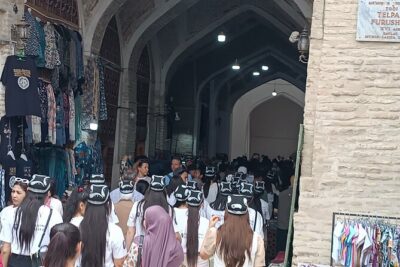
Browse the lists this tour appears in