
Reviewed · BUKHARA TOURS
Bukhara Full Day Old City Private Tour
Bukhara’s Old City is interesting because it feels like you are stepping into an 1001-night story, with monuments that survived centuries of change. What makes this tour work is the fully licensed local guide plus a tight loop of the city’s most important places. When I read about guides like Sunny and Shakhnoza leading groups, the common thread was clear, thoughtful storytelling that turns stone and tiles into real context.
I especially like that the tour is walk-based and ticket handling is taken care of for the monuments, so you can focus on seeing, not stopping to figure things out. One thing to consider is the schedule is pace-focused, with several stops that are only 15 to 30 minutes, so if you want long museum-style time everywhere, you may need to plan extra free time.
Key highlights you will actually feel on the walk
- Private tour format so your group sets the rhythm, and your guide can answer your questions as you go
- Entrance tickets included for the ticketed sites, which makes a big difference in hassle and budgeting
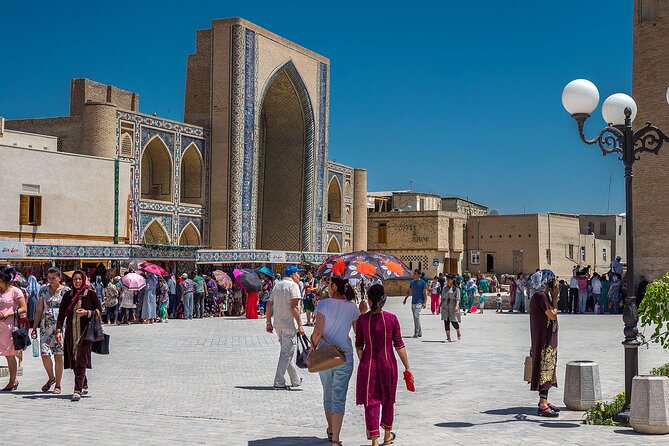
- Kalyan Square views and photo moments, especially around the towering minaret and surrounding mosque complex
- Ark of Bukhara as the one longer stretch, giving you time to grasp how this fortress shaped the city
- Lyabi-Hauz square area with its ensemble of buildings, plus nearby mosques and shade for a quick reset
- Silk Road era variety, from madrasas and trading domes to a synagogue stop that broadens the story
Entering Bukhara like a story, not a checklist
Bukhara is not one monument. It is a whole system of places that link religion, learning, power, and trade. That is why a guided walking loop works better here than hopping from one stop to the next on your own. You start to notice patterns: how courtyards are arranged, where streets funnel you back toward major squares, and how tiles and calligraphy are used like visual language.
This private tour is priced at $85 per person for a full-day feel, usually about 5 to 7 hours. It is built around major stops that you can reach on foot inside the historic core. And because it is private, the guide can slow down for your questions or speed up if you want to keep moving. That flexibility shows up again and again in the guide feedback, including stories from different guides such as Maksad, Guzel, and Guli who adjusted for breaks and shopping time.
More of Bukhara worth pencilling in
- Best of Bukhara: All Day Private Old Town Tour
★ 5.0 · 66 reviews - Best of Bukhara: All Day Private Old Town Tour
★ 4.9 · 62 reviews - Legends of Bukhara: Exclusive Full-Day Tour
★ 5.0 · 4 reviews
Price and value: what $85 buys you in the Old City
Let’s talk value without sugarcoating it. You are paying for three things here: local guide time, admission tickets, and a smooth flow through the Old City.
First, entrance tickets are included for the listed monuments. That matters in places like Bukhara where tickets can stack up if you do everything on your own. Second, you get a fully licensed guide who can explain what you are looking at in plain terms. Third, you spend your limited time in Bukhara seeing, not coordinating.
There are also practical extras. You get a mobile ticket, and pickup is offered from the meeting point area. The tour is booked in advance often enough that planning ahead helps, with an average booking window of about 46 days. If you are traveling in a busier season, I would lock it in early.
One more small cost to keep in mind: there can be photo or video charges paid directly to museums, listed as $1 per site. That is not included, so if photography matters to you, budget a little.
Getting picked up and setting the pace
The tour starts and ends back at the meeting point: Hotel Malika-Bukhara, Gavkushon Road 25. Pickup is offered, and the tour is described as near public transportation, so you are not stranded if your plans shift.
Because this is a private tour, it stays focused on your group only. That typically means fewer awkward pauses and less time waiting around for other people. It also usually means your guide can tailor small route choices, especially if you want extra time near an especially photo-friendly corner.
Expect lots of walking in the historic center. Some stops are long enough to feel like more than a photo stop, and others are short. For example, you can easily spend about 1 hour at the Ark, while several madrasas and mosque-related stops are 15 to 30 minutes each. If you tend to wander slowly through details on your own, you will still enjoy it, but ask your guide for a “long look” moment at the places you care about most.
Kalyan Square: the Po-i-Kalyan complex and the wow factor
You begin in the Kalyan area, one of the most iconic sections of Old Bukhara. This is where the city makes its big visual statement.
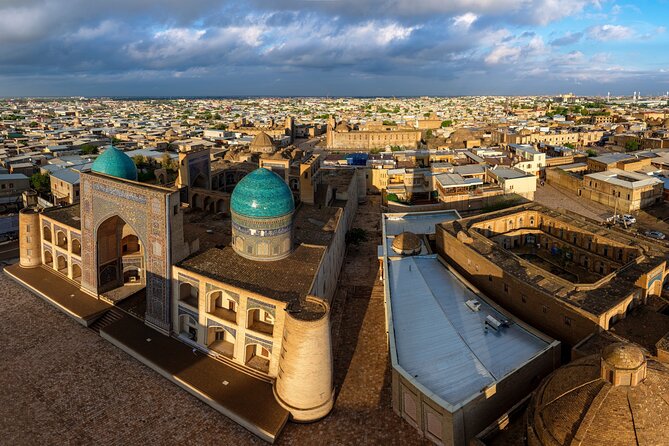
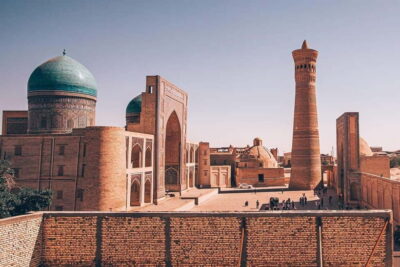
You will see the Great Minaret of the Kalon (Kalyan Minaret) first. It is part of the Po-i-Kalyan mosque complex, and it is the landmark people point to for orientation. The minaret is tall enough that it changes how the square feels, even if you are just standing at ground level.
Then you move into the larger picture of the complex, which includes the Kalan Mosque, the Kalan Minaret, and the Mir-i-Arab Madrasah. Even when individual buildings have their own entrances and details, your guide helps you understand how they connect as one religious and educational zone.
A practical tip here: plan your photos around light. Mornings can make tiles and inscriptions pop, while later in the day you may get warmer tones and longer shadows. Either way, this is a place where you will naturally want a moment to just look up.
An easier afternoon once Bukhara is done:
- Bukhara: Walking Tour with a Small Group
★ 4.9 · 260 reviews - From Bukhara: 2-Day Desert Yurt Camp Tour
★ 4.5 · 57 reviews - City Tour Around Bukhara
★ 5.0 · 55 reviews - Bukhara: Historic Center Guided Sightseeing Tour
★ 4.8 · 44 reviews
Mir-i-Arab Madrasah and Chor Minor: learning centers with character
Bukhara’s madrasas are not just quiet old schools. They are also architecture lessons. The courtyards, tiles, and entrances tell you how students lived, studied, and moved through space.
The stop at Mir-i-Arab Madrasah gives you that sense immediately. You will see a striking college with intricate tilework and a vast hall. You also get the courtyard connection that links the madrasa world with mosque life.
Next is Chor Minor Madrasah, also known as the Madrasah of Khalif Niyaz-kul. This is especially interesting because it is tied to a gatehouse for a now-destroyed madrasa. So even if parts of the structure are gone, the story of what once stood there still matters. Your guide can explain why a surviving gatehouse can feel more meaningful than you might expect.
Drawback to note: these stops are shorter. You will not have hours inside every courtyard, so be ready to watch for the key details your guide points out, rather than trying to read everything yourself in one pass.
The Ark of Bukhara: power, city memory, and scale
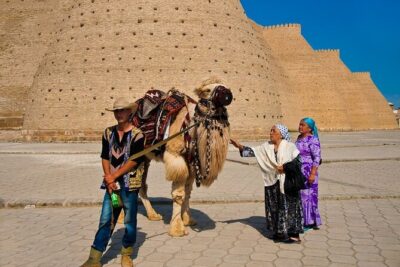
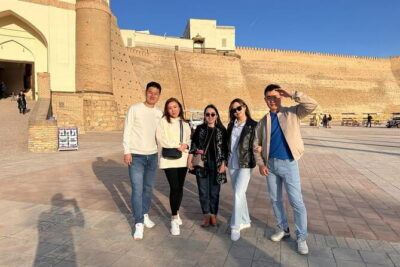
Then you step into the Ark of Bukhara, the massive fortress in the city center. The Ark was initially built and occupied around the 5th century AD, which helps you understand why Bukhara developed as it did. Even if you are not a history buff, the sheer mass of a fortress gives context fast.
This is one of the best “time value” stops because you get about 1 hour here, not 15 minutes. That time buffer matters. The Ark is not only a single building you walk past. It is a complex area where you can grasp how rulers protected the city, managed authority, and shaped daily life around the fortress.
What you might not expect is how quickly your brain starts connecting other stops to this one. When you later see madrasas and mosque complexes, the Ark helps you understand why power and religion were linked in this city.
Po-i-Kalyan area again, because the city repeats with purpose
After the Ark, the tour circles back toward the Poi Kalyan Mosque complex area, or at least connects to it through time and routing. This is not repetition for its own sake. It is a way to help you appreciate the full complex from different angles.
When you return to Po-i-Kalan, you are looking at the same set of parts, but with fresher context in your head. You will spend around 20 minutes, so treat it as a “make sense of it now” stop. You will likely notice alignment between the minaret, the mosque spaces, and the surrounding madrasas more clearly after seeing the Ark first.
Lyabi-Hauz: square life, shade, and architecture that frames people
Next comes Lyabi-Hauz, one of Bukhara’s most central, human-scale ensembles. It is formed by three large monumental buildings: Kukeldash Madrasah, the khanaqah, and Nodir Divan-begi.
The reason I like this stop is simple. Courtyards and squares in Central Asia are social engines. Even if you are not there at peak evening crowds, you can still feel how the architecture frames people, conversations, and slow moments.
You get about 30 minutes here. That is long enough to appreciate the setting and then move on without feeling rushed.
Right nearby is Bolo Haouz Mosque on the opposite side of the Ark in the Registan district area. It dates to 1712, and it is inscribed as part of the UNESCO World Heritage listing with other sites. Your time here is shorter, about 15 minutes, but it is a good chance to connect newer layers of the city story to older power structures.
Nodir Devon Begi Madrasasi: gatework and a lively inner world
Another stop you will not want to skim is Nodir Devon Begi Madrasasi. This is described as a lively complex with an ornate, mosaic-covered gate and a courtyard that connects to shops and even folk dance shows.
The standout for most people is the gate. Mosaic work and tile patterns here are not only pretty. They are how the city signals its identity at the entrance to important spaces.
You have about 30 minutes, which is usually enough to see the gate, walk the courtyard edge, and understand how the complex functions like a small world inside the larger city.
Hodja Nasreddin monument: the humor break you did not know you needed
Then there is a short, free stop: the Monument to Hodja Nasreddin in the central city square by Lyabi-Hauz, installed in 1979.
It is a quick 15-minute breather. But it also adds balance. Bukhara’s story is often told through grand architecture, yet Nasreddin is a human character, associated with humor and cleverness. It gives you a different lens on local culture, and it is a nice moment to reset before the next set of madrasas.
Trading Domes: the Silk Road side you can walk through
After the more “sacred and educational” stops, you head toward the Trading Domes, with four domes remaining in the ancient city. They sit on a north-to-south route through the old city.
This is a stop that changes the mood. You are seeing the trade pattern, not just the religious and scholarly architecture. It is also a reminder that these institutions were supported by economic life.
You get about 1 hour here. That makes it one of the best opportunities to slow down, browse small shops if you want, and understand how the old city’s commercial routes still shape movement today. Entrance here is listed as free.
If you care about shopping, this is where your guide can help you compare items across stalls. If you do not care about shopping, you can still use the time to understand the space and watch how locals and visitors move through the domes.
Abdulaziz-Khan and Ulugbek madrasas: science, tiles, and tombs
The tour then continues into a cluster of madrasas that highlight different layers of learning and patronage.
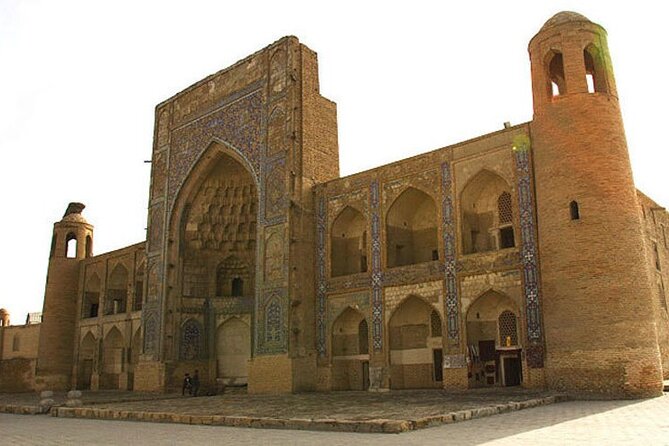
Abdulaziz-Khan Madrasah connects to Ulughbek as a scholar and patron of sciences. The details here include that Ulughbek’s first madrasa was built in 1417 in Bukhara. This is the kind of fact your guide makes useful by connecting the architecture to the people behind it.
Then you see Ulugbek Madrasah, completed in 1420, described with exterior tiles, a fluted dome, stained windows, and old tombs. This is one of the stops where you will likely get the best “wow” from the building surface. The tiles are not just decoration. They help define the identity of the place.
Time is short, about 20 minutes per madrasa. Because of that, I recommend you decide before you start which details you care about most: exterior tilework, domes and windows, or tomb areas. Tell your guide your focus, and you will get a better experience than trying to take everything in at once.
Maghoki Attori Mosque and the Lyabi-Hauz religious loop
You return to the Lyabi-Hauz orbit with Maghak-i Attari Mosque. It is described as part of the Lyab-i Hauz historical religious complex.
Even in a quick 20-minute visit, this stop can help you understand the “network” idea. Bukhara is not a single museum. It is a religious neighborhood system where mosques, madrasas, and social spaces overlap in daily life.
If you want a calm moment, this is often a good place to catch your breath, because your guide can point out how the design supports prayer and circulation even if you are just walking through.
Bukhara Synagogue: a different thread in the Silk Road story
One free stop you should not skip is Bukhara Synagogue. The tour notes that the Jewish community in Bukhara had a great contribution to Central Asian and Great Silk Road civilization.
This stop is about more than a building. It expands the lens of Bukhara. When you spend the morning with mosques and madrasas, it helps to see how a long-established community lived within the same historic city system.
It is about 30 minutes, giving you enough time to understand the point of the stop without rushing.
Practical things to plan for during a walking day
This is a full Old City walk, so comfort matters.
Wear shoes you trust. The sites are spread through historic streets and courtyards where you do not always have smooth pavement. Bring water if you can. The tour includes entrance tickets, but it does not list water or meals as part of the included items.
Lunch is not planned as a named included stop in the tour details. A helpful strategy is to tell your guide midway that you want a break and ask for a simple lunch option, ideally close to where you are walking anyway. One of the most praised guide styles in the feedback is exactly this kind of practical adjustment, including guides who helped arrange a meal when needed.
Also, if you love photos, remember the $1 per site museum photo or video charge might apply. Keep some small cash or a payment method ready for those moments.
Who this tour is best for, and who might want a different plan
This tour is best for you if:
- you want a guided introduction to the major Old City sites without spending time working out tickets and routes
- you enjoy history and architecture, but you also want a guide to tell you what to notice in each place
- you like the idea of a private tour where you can ask questions and adjust timing slightly
It might be less ideal if:
- you want long stays inside every building, since several stops are only 15 to 30 minutes
- you plan to take a very slow, solo wander day where you do not want a structured flow
That said, the structure is also the charm. You get a full sense of Bukhara’s different “worlds” in one day.
Should you book the Bukhara Full Day Old City Private Tour?
In my view, you should book this tour if you want the highest chance of getting real meaning out of Bukhara, not just photos. The big strength is the combination of licensed local guidance and included monument tickets for the key sites. At $85 per person, it is not cheap, but it is fair for a private day that saves you the friction of planning.
If you pick a guide whose style matches you, this becomes a standout Bukhara day. Feedback highlights guides like Sunny, Maksad, Shakhnoza, Bekhruz, and Malika for being punctual, flexible, and generous with explanations, even helping with practical needs like getting cash and finding food. That is the difference between seeing buildings and understanding a city.
If you are short on time and want the “greatest hits” of Old Bukhara with context, this is a strong yes.
FAQ
How long is the Bukhara Full Day Old City Private Tour?
It runs for about 5 to 7 hours.
How much does the tour cost?
The price is $85.00 per person.
Is pickup available, and where does the tour start?
Pickup is offered. The meeting point is Hotel Malika-Bukhara, Gavkushon Road 25, Bukhara.
Are entrance tickets included?
Yes. Entrance tickets to all monuments are included in the tour.
Do I need to pay extra for photos or videos?
Photo or video charges may apply. The tour notes you pay directly to museums, listed as $1 per site.
Is this a private tour?
Yes. It is a private tour, and only your group participates.
Do I need to bring a ticket?
You will receive a mobile ticket.
Is lunch included?
Lunch is not listed as included. If you want a break to eat, you will need to ask your guide.
Can I cancel for a full refund?
Yes, you can cancel up to 24 hours in advance for a full refund.
What if I am traveling by public transportation?
The meeting point is near public transportation, which makes it easier to reach if needed.
Latest reviews out of Bukhara
- Uzbekistan 8 Days Private Guided Tour★ 4.6 · 3 reviews
- Bukhara: City Highlights Guided Tour with Pickup★ 5.0 · 3 reviews
- Bukhara day tour★ 4.0 · 4 reviews
- Bukhara Private City Tour★ 2.5 · 4 reviews
- Legends of Bukhara: Exclusive Full-Day Tour★ 5.0 · 4 reviews
- 2 Day Ukhum Hiking Tour from Bukhara★ 5.0 · 4 reviews
- From Bukhara: 3-Day Yurt Stay, Hiking & Lake Aydarkul★ 5.0 · 5 reviews
- Bukhara day tour. Departure from Tashkent or Samarkand.★ 5.0 · 7 reviews
Bukhara Tours, compared.
All You Need To Know About Bukhara. A Walk In The Town
Read our review →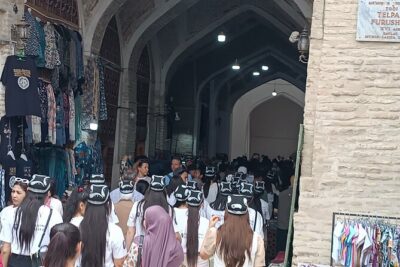
Bukhara Historical City Highlights Guided Walking Tour
Read our review →Browse the lists this tour appears in