
Khiva feels like Central Asia turned into a living set, with fortress walls and the city’s famous minarets built right into daily life. This is the kind of place where the old city is the main attraction, not a background. You’ll follow the story through the main monuments, from the citadel viewpoints to the prayer halls and madrasas.
Two things I especially like: the focus on the city as an open-air museum, and the way the route strings together major sites like the Kunya Ark citadel and the Djuma Mosque. The one drawback to think about is that some big-ticket experiences are not fully included, like going up minarets, and entrance tickets for the listed sights can be extra.
Key points to know before you go

- UNESCO old city momentum: Khiva is the kind of historic place where the layout itself teaches you what matters.
- Citadel and palace highlights: You get panoramic viewpoints tied to power, government, and ceremonies.
- Djuma Mosque stop: A carved-column interior that anchors the religious side of the tour.
- Islamkhudja symbolism: The complex is treated as a signature of Khiva, including its tall minaret.
- Madrasas as learning hubs: You’ll see several major schools and their distinct roles.
- A bread-oven glimpse (maybe): Clay-oven bread is possible, but it depends on luck.
Khiva UNESCO old city: why the “thousand minarets” story is more than a slogan

Khiva is often described as the City of a Thousand Minarets, and that image is not just marketing. As you walk, you start noticing how minarets, domes, courtyards, and brickwork line up like a visual calendar. The city has long been called an open-air museum, and even if you are not a museum person, this is the sort of place where streets feel curated by centuries of rebuilding.
One reason it hits so hard is continuity. Khiva is described as the only Central Asian city that remains on the same spot where it was founded. Whether you take that literally or more as a cultural truth, it changes how you experience the streets. You are not comparing old ruins to a modern city. You are stepping into the same enclosed world that shaped the architecture in the first place.
And yes, Khiva was the first Central Asian city accepted into UNESCO World Heritage. That usually means you can trust the “why” behind the monuments, not just the photos. UNESCO matters here because it signals protection of a whole urban fabric, not one single monument you can check off and move on.
More of Khiva worth pencilling in
- Khiva: Historical City Highlights Guided Walking Tour
★ 4.8 · 156 reviews - Transfer: Bukhara – Khiva via Ancient Fortresses
★ 4.5 · 101 reviews - Daytrip From Khiva To Ancient Fortresses
★ 4.6 · 60 reviews
Entering through Ata Darvaza: how the route starts and why the timing matters

Your tour begins at 09:00 or 15:00, at the main gate of the old city, specifically the Western gate called Ata Darvaza. You meet at the ticket office at the main gate. This matters because Khiva’s old-town experience is easiest when you enter with momentum. If you go too late, light and crowding can make certain courtyards feel rushed. If you go too early, some areas may still feel slow in terms of everyday activity.
The duration is about 4.5 hours, with a typical 4 to 5 hour range. This is the sweet spot for first-timers. You get to see the main “big names” without spending the whole day walking and re-reading guidebook plates.
The tour also includes a professional English-speaking guide, plus a skip-the-ticket-line benefit. That can save time, especially when multiple sites require separate entry. The big reminder is that entrance tickets to the specified objects are not included, so you will want cash or a card ready for multiple stops.
Kunya Ark and Tosh Hovli: the power sites that make Khiva feel personal

If Khiva is a stage, the khans built their backstage here. The route includes Kunya Ark, the ancient citadel and palace zone, and it is where you get a sense of how rulers showed authority through space.
At Kunya Ark you’ll see a panoramic view tower, plus areas associated with coinage and reception spaces. The tour also points you toward summer and winter khan reception areas, which is a small detail with big meaning. It tells you the city wasn’t designed for one climate. People lived with heat, sun, and season, and architecture responded.
Next comes Tosh Hovli Palace, the second khan palace with a harem and reception rooms for different seasons. The tour notes summer and winter receptions, a secret corridor, and a special reception area. It also includes a mention of a gift carriage linked to Tsar Alexander III. Even if you cannot visualize every corridor from ground level, hearing how these spaces were used changes your walk through the rooms. You stop treating it like “pretty walls” and start treating it like a system.
One practical thing to consider: these areas can feel busy inside and slightly uneven underfoot. You’ll want comfortable shoes. The route is not described as an easy stroll, so wear footwear that can handle uneven stone and compact streets.
Madrasas and the city’s learning architecture: Muhammad Aminkhan to Allakulikhan

Khiva’s educational buildings are not side notes. They are core monuments, and the tour hits several.
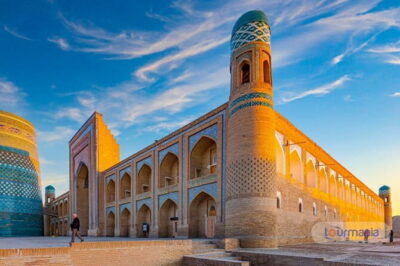
You’ll visit Muhammad Aminkhan medrese, described as the largest in this territory. That size matters because it frames how powerful religious and scholarly institutions were. You’ll also see Muhammad Rahimkhan II medrese, along with Allakulikhan medrese and Kutlug Murad medrese, which is noted as a museum of surrealist paintings.
That last item is a helpful reminder that the tour is not trapped in the medieval world. Even if you came for minarets and mosques, the presence of a surrealist-painting museum inside a madrasah setting gives the city a modern layer. It is a contrast that can make the architecture feel less like a frozen postcard.
The tour also includes Djuma Mosque and a set of other madrasa complexes, including Allakulikhan medrese and others in the route. While each madrasa has its own identity, you’ll get the bigger theme: Khiva built its public life around teaching, prayer, and ceremony. These buildings functioned as both spiritual hubs and social infrastructure.
If you like guided context, madrasas are where a good English guide can turn walls into stories. That came through in the strong review notes you provided, where the best experiences were tied to clear explanations and friendly guidance.
An easier afternoon once Khiva is done:
- Ayazkala, Toprakkala & Kizilkala Fortress Tour From Khiva
★ 4.3 · 33 reviews - Aral Sea Adventures (2 day)
★ 5.0 · 30 reviews - Khiva Historical City Highlights Guided Walking Tour
★ 5.0 · 30 reviews - Master Class – Shivit Osh Traditional Food Of Khiva
★ 4.2 · 27 reviews
Kalta Minor and the minaret skyline: what you can see versus what you cannot

The route highlights Kalta Minor minaret, one of the city’s most recognizable silhouettes. Minarets in Khiva are not just decorative. They mark religious presence and give the skyline a hierarchy, almost like a visual wayfinding system.
That said, pay attention to what is not included. The tour specifies that going up to minarets is not included. You can still appreciate the minaret from ground level and learn about it, but if you were hoping for climbing views from the top, you’ll need another option.
Also plan for the practical side of a minaret-heavy route. Even if you are not climbing, you’ll be turning your head up often, and you might step into shaded areas then back into sun. Bring comfortable clothes and plan for weather swings, especially if you choose the afternoon 15:00 start.
Djuma Mosque: the columned interior that makes the city feel enclosed and alive

The Djuma Mosque is a standout stop, and the tour description gives you a key detail: it has more than 120 carved columns. That’s the kind of number that stops you from thinking of it as a simple hall and starts you thinking of it as a dense forest of stonework.
A columned mosque changes your sense of scale. Instead of one open vista, you get repeating pillars and shadow lines. With a guide explaining what you are looking at, you can start to notice patterns in carving and structure, rather than just appreciating the fact that it exists.
This is also where Khiva’s “open-air museum” idea becomes real. Even while you are inside, the mosque feels connected to the city’s overall identity. The religious architecture becomes part of the street-level experience, not a separate indoor attraction.
Islamkhudja complex: Khiva’s signature and the story behind the tallest minaret

If you want one place that feels like Khiva’s calling card, the Islamkhudja complex is it. The tour describes it as a symbol of Khiva and includes an important detail: it features a minaret that is the tallest in this region.
The complex also includes a medrese-adapted art museum. That matters because it shows how Khiva’s identity is not only in grand religious forms. Art museums in historic religious buildings give you a way to slow down and look beyond the main monument photos.
The tour also references Islamkhudja school, described as the first modern and secular school. That is a big idea, especially when you are walking through a city where mosques and madrasas feel dominant. This stop can rebalance your understanding. It tells you Khiva was not only shaped by one era. It adjusted, at least in part, to new ideas about education.
Pahlavan Makhmud, plus the “bread in the street” moment that depends on luck

The itinerary ends with Pahlavan Makhmud complex, described as the cherry on the cake of your visit. That phrase might be a bit dramatic, but it points to a real travel truth: you want a final stop that feels satisfying, not just another building.
This is also where you may catch a local food moment. Along the way, you might have an opportunity to see how local bread is prepared in a clay oven. It is not guaranteed, it depends on luck. I like including this kind of “maybe” in a tour because it keeps you curious and present. When it happens, it’s one of those small, real-life moments that you cannot replicate at a museum.
If the bread-oven moment does not happen, you are not left empty-handed. The rest of the route is still built around major monuments, so you keep your core value. Still, if you really care about food demonstrations, I’d treat this as a bonus, not a promise.
Price and value: what $45 buys you in Khiva’s maze

At $45 per person for a 4.5-hour guided walk, this tour is priced like a budget-friendly “first look” option, not a luxury private expedition. For that price, you get a professional English-speaking guide and a skip-the-ticket-line advantage.
Here is the real value math: the guide can be the difference between a collection of names and a coherent route you understand. In your provided reviews, the highest praise focused on friendly guides, clear explanations, and even added personality, like good photography skills. When your guide is strong, each madrasa and mosque stops feeling repetitive, because the explanations create contrast.
The tradeoff is that entrance tickets to the specified objects are not included, and there is also an exclusion for going up to minarets. So plan your total spend as: tour price plus whatever entrance fees apply at multiple monuments. Because you are visiting several sites, it’s normal to pay more than one entry fee.
Still, skipping the ticket line helps you use more of your paid time inside the city’s monuments. For a half-day experience, that time savings matters.
What you should wear, bring, and avoid
Khiva walking is mostly on stone and within an enclosed old-city layout. For this tour, bring comfortable shoes and comfortable clothes. You’ll be on your feet for the full 4.5-hour pace.
The tour also notes not to smoke indoors. I’d also suggest carrying water, even if it is not mentioned, because you may be moving between sun and shade.
If you are planning for photos, do not only aim at minarets. Look for doorways, tiled patterns, and the rhythm of courtyards. A guide who explains will help you aim at the right details, not just the biggest skyline views.
Best-fit traveler: who this Khiva tour suits (and who might want more)
This tour fits best if you want a guided first visit to Khiva with a structured route. If you like architecture, religious sites, and learning buildings, you’ll feel satisfied because the itinerary is built around mosque, madrasah, minaret, and mausoleum-style complexes.
You might want to choose a longer or different add-on if your top priority is climbing minarets. Since going up to minarets is not included, you will only get the external views and explanations from ground level.
It’s also a good choice if you want a simple logistics plan: a fixed meeting point at Ata Darvaza, English guidance, and a clear time window. If you are short on time but still want the “greatest hits,” 4.5 hours is a strong compromise.
Should you book the Khiva Guaranteed Tour?
Book it if you want a smart, guide-led circuit through Khiva’s most important monuments, with enough time to understand why each site matters. The overall rating you shared, 4.8 based on 17 reviews, plus the repeated praise for guides being friendly and well versed, is a good sign that this isn’t just a checklist walk.
I’d be cautious if you expect everything to be fully included inside every monument, or if you specifically want to climb minarets. Entrance tickets are not included for the listed objects, and going up minarets is explicitly not part of this plan. If you adjust your expectations, this becomes excellent value for a half-day Khiva introduction.
If you get a guide like Farhod, based on the high praise you provided, you’re likely to get the kind of explanations that turn Khiva from a pretty city into a city you actually understand.
FAQ
How long is the Khiva Guaranteed Tour?
The tour lasts about 4.5 hours, with a range of 4 to 5 hours depending on timing.
What time does the tour start?
Start times are 09:00 or 15:00. You can check availability for the specific starting time you want.
Where do I meet the guide?
You meet at the ticket office of the main gates of the old city, at the Western gate called Ata Darvaza.
Is an English guide included?
Yes. The tour includes a professional English-speaking guide.
Are entrance tickets included?
No. Entrance tickets to the specified objects are not included, and there can be multiple sites that require tickets.
Is going up minarets included?
No. Upstairs access to minarets is not included.
Does the tour include a bread-baking stop?
You might have the chance to see local bread prepared in a clay oven, but it depends on luck and is not guaranteed.
What should I wear and bring?
Wear comfortable shoes and comfortable clothes. You will be walking through the old city for the full tour duration.
Is the tour wheelchair accessible?
The tour is listed as wheelchair accessible. If you have specific mobility needs, it’s smart to confirm details with the provider before going.
Latest reviews out of Khiva
- Khiva: classic Half-Day Tour★ 3.7 · 3 reviews
- Khiva: City Highlights Guided Walking Tour★ 4.6 · 3 reviews
- Master Class – Uzbek Bread (Khiva)★ 3.5 · 4 reviews
- Traditional Khiva Cooking Class with Market Visit & Lunch★ 5.0 · 4 reviews
- Old Khiva Stories with Your Local Guide★ 5.0 · 5 reviews
- A Night In The Kyzylkum Desert [2] From Khiva★ 4.5 · 3 reviews
- Khorezm Fortress and KyzylKum Desert Private Tour★ 5.0 · 3 reviews
- Kunya Urgench Day Tour from Uzbekistan★ 1.3 · 3 reviews
Khiva Tours, compared.
Transfer: Bukhara – Khiva via Ancient Fortresses
Read our review →
Khiva Historical City Highlights Guided Walking Tour
Read our review →
Private Daytrip to 7 Ancient Fortresses of Khorezm
Read our review →
From Khiva To Aral Sea 2-Days One Night In Yurt Stay
Read our review →Browse the lists this tour appears in