
Reviewed · KHIVA TOURS
Old Khiva Stories with Your Local Guide
Khiva’s Itchan Kala feels like a living museum, and this walking tour helps you understand what you’re actually looking at. You’ll move through narrow lanes of the UNESCO walled city in a tight, sensible loop that makes history easy to follow. With Sarvar as your guide, you get the inside view without the usual museum-stiffness.
I especially like two things. First, you’ll hear English storytelling that connects the big names in Khiva to the buildings you pass, like Muhammad Amin Khan and Islom Khodja. Second, you get a real craft stop at a UNESCO wood carving workshop, so the city’s art traditions feel practical, not just decorative.
One consideration: the tour price does not include the site admissions. You should budget about 250,000 sum per person for the museum ticket that covers 10 to 13 museums.
Key things to know before you go
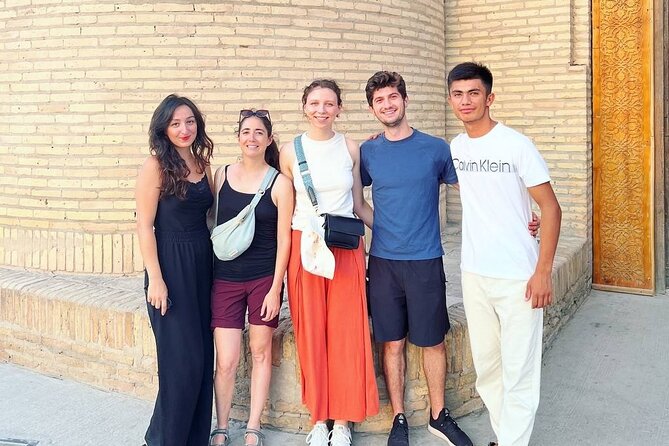
- English-speaking guide who’s local to Khiva, so you get context that sounds like everyday life, not textbook history
- Itchan Kala in about 3 hours, an ideal length for seeing the core without burning the whole day
- Iconic landmarks plus a craft workshop, including wood carving by UNESCO artisans
- Museum admissions are separate, with an all-in ticket approach for around 10 to 13 sites
- Small groups up to 15 people, so questions stay possible and the pace doesn’t get chaotic
- A strong mix of power, religion, and daily life, from Kuhna Ark to Juma Mosque and the market caravanserai
Why Itchan Kala works so well on foot
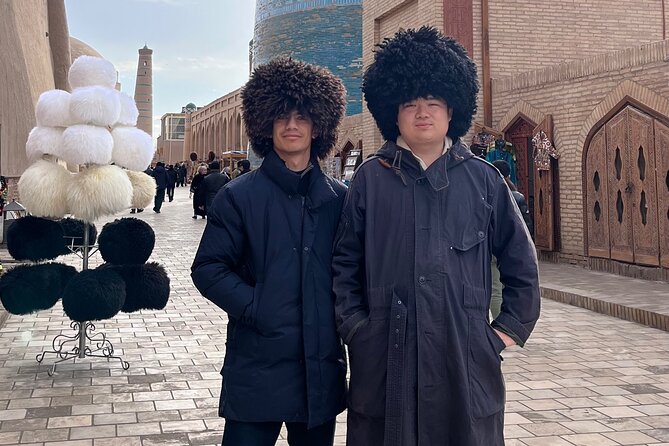
Khiva’s walled inner city, Itchan Kala, is the kind of place where getting the order right matters. If you wander solo, you can see beautiful buildings and still miss the “why.” This tour gives you a route that links gates, schools, palaces, and mosques into one clear story.
The time window also helps. At about 3 hours, you can focus on the core without feeling like you’re constantly checking your watch. Since the walking is inside the walled area, you’re also not constantly zigzagging around town.
And because the group size tops out at 15 people, you’re usually not stuck behind a moving wall of bodies. It makes it easier to stop, look closely at tilework, and actually listen.
More of Khiva worth pencilling in
- Khiva: Historical City Highlights Guided Walking Tour
★ 4.8 · 156 reviews - Transfer: Bukhara – Khiva via Ancient Fortresses
★ 4.5 · 101 reviews - Daytrip From Khiva To Ancient Fortresses
★ 4.6 · 60 reviews
Starting at Ata Darwaza, the gate that sets the tone
The tour begins at the Ichan Kala west gate (meeting point listed as 99H4+CRQ). You’ll start right at Ata Darwaza, the main entrance into the walled city.
This matters more than it sounds. Gates in Khiva were not just decorative. They were part of the way caravans entered, traded, and lived through the rhythms of the Silk Road. Even if you only remember one thing from this first stop, it should be this: the city was built to receive travelers, not just impress them.
Practical tip: arrive a few minutes early. In Itchan Kala, it’s easy to get turned around before the group forms.
Muhammad Amin Khan’s world: Madrasah, then Kalta Minor
From the gate, you move to two of Khiva’s most recognizable power-and-learning symbols.
First is the Mohammed Amin Khan Madrasah, built in 1851. It was the largest Islamic school in the region at the time, with space for over 250 students. Standing there, you’ll see the building as an institution, not only architecture. In practical terms, this is where education and status lived side by side.
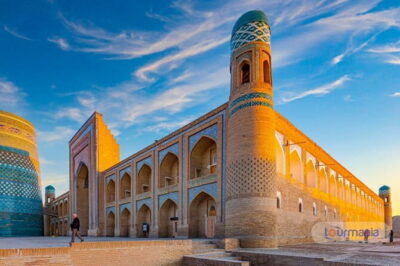
Right next to it is the Kalta Minor Minaret, Khiva’s iconic turquoise landmark. It was also built by Muhammad Amin Khan, and its short, wide shape makes it easy to recognize from a distance. The tiles and color are what most people notice first, but your guide should help you read the minaret as a statement of ambition.
If you like cities where religion, education, and politics share the same physical space, these two stops are a strong start. They set the tone for what comes next in the fortress and palace areas.
Inside Kuhna Ark: the khans’ fortress life
Next you step into Kuhna Ark, Khiva’s historic fortress complex and former residence of the khans. This part of the tour is where you shift from schools and monuments to daily power.
Kuhna Ark includes spaces like a throne room, harem, mint, mosque, and reception areas decorated with serious craftsmanship. Even if you’re not a “fortress person,” the value here is the mix. It helps you understand that a khan’s life was not only about ruling in public. It was also about managing wealth, religion, and authority behind walls.
A consideration: fortress interiors can feel dim and sometimes crowded as you move room to room. Keep your patience. The most rewarding moments tend to be when you pause and look at details your eyes might skip if you rush.
An easier afternoon once Khiva is done:
- Ayazkala, Toprakkala & Kizilkala Fortress Tour From Khiva
★ 4.3 · 33 reviews - Aral Sea Adventures (2 day)
★ 5.0 · 30 reviews - Khiva Historical City Highlights Guided Walking Tour
★ 5.0 · 30 reviews - Master Class – Shivit Osh Traditional Food Of Khiva
★ 4.2 · 27 reviews
UNESCO wood carving workshop: what to watch for
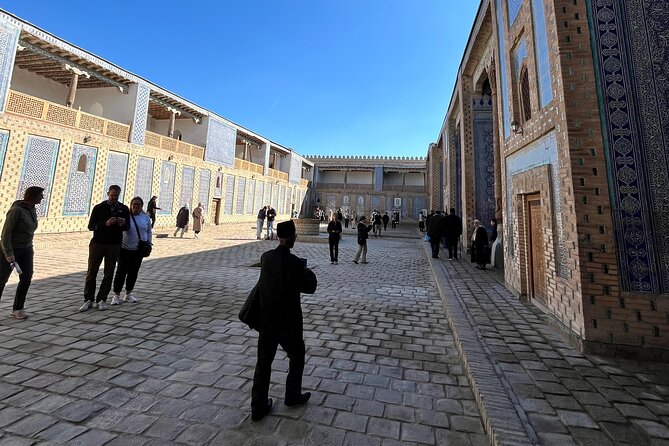
One of the most rewarding stops is the Khiva wood carving workshop, tied to UNESCO and centered on a tradition passed down through generations.
This is not set up as a “sit and listen” presentation. The point is to watch artisans at work, creating intricate pieces like carved columns and doors. If you’ve ever wondered why Khiva looks the way it does, this workshop connects the dots. Woodwork here is part of the same artistic world as tiled domes and carved stone details.
What to pay attention to:
- tools and how craftsmen move their hands through fine patterns
- how the designs repeat across doors, columns, and interior features
- the feel of the process, slow and precise, rather than mass production
If you’re the type of traveler who enjoys crafts, this stop alone is worth planning around.
Scholars Museum: Al-Khorazmiy and friends in Khiva
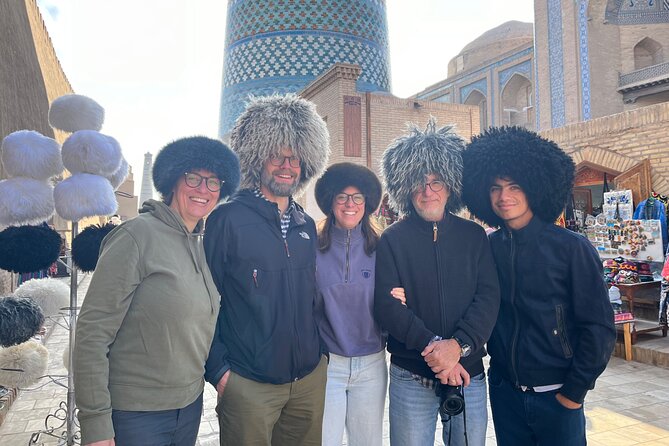
After the craft focus, the tour shifts again with the Scholars Museum. Here you talk about major scholars connected to Uzbekistan and world civilization, including Al-Khorazmiy, Al-Beruniy, Zamaxshariy, and Abu Ali Ibn Sino.
This stop is useful because it adds one more layer to the city. Khiva is often discussed in terms of rulers and architecture, but education and science also belong in the story.
A practical way to enjoy this section: use it as a mental checkpoint. After seeing a madrasah and minarets, it’s nice to connect the spiritual and educational themes to the broader intellectual legacy of the region.
Tash Khauli (Tosh Khovli): the palace you pay extra to enter
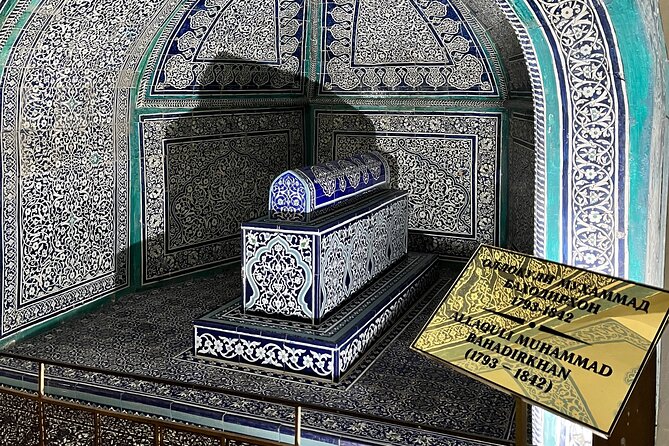
Next is Stone Palace, Tash Khauli, also known as Tosh Khovli Palace or Allakulikhan Palace. This one is a paid entry site, listed as not included.
The palace was built in the 19th century and served as a residence of the khans and their court. This is where you see architecture used for comfort and status, not only public display.
Value tip: if you’re deciding whether to prioritize photos or story, this is the place to slow down. Palace spaces often include small decorative transitions that make a big difference in how the whole room feels.
Allakuli Khan Tim Market and the caravanserai stop for shopping
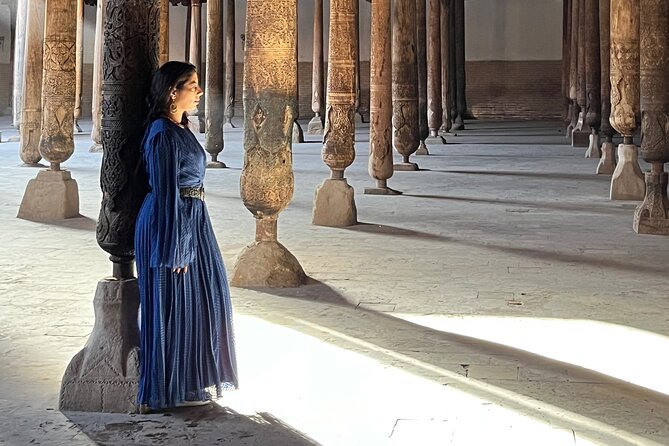
Then comes Allakuli Khan Tim Market, tied to the preserved Allakulikhan Caravanserai. This is listed as a free stop for the tour portion, and it’s also where shopping becomes part of the experience.
You’ll find places to browse and pick up local souvenirs, and you’re seeing a building connected to the caravan culture that made cities like Khiva possible. The caravanserai is described as a beautifully preserved stop along the ancient Silk Road, built in the 17th century.
For shopping, go in with a plan. Decide what you want before you start walking. It makes negotiation easier and keeps you from feeling like every stall is competing for your attention.
Juma Mosque: the forest of wooden columns
The Juma Mosque is one of Khiva’s most unique landmarks, and it’s a highlight for a reason.
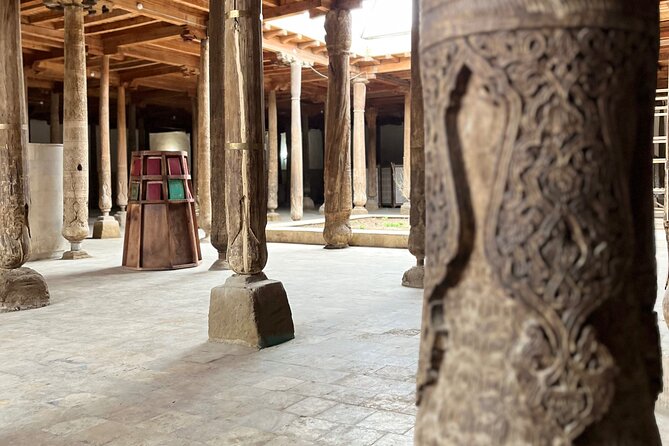
It’s known for its 215 wooden columns, each intricately carved. The mosque is described as built in the 10th century, and the columns create a kind of forest effect that mixes Islamic architectural ideas with local craftsmanship.
How to enjoy it:
- don’t rush through the first impression
- look up and then back across the room, because the columns shape your sense of space
- listen to how your guide frames the columns as part of the overall design
This is also a good place to take a break from the brightest tiles and minaret colors. The mood in a mosque interior is cooler and more grounded.
Islom Khodja complex: the tall minaret that anchors the view
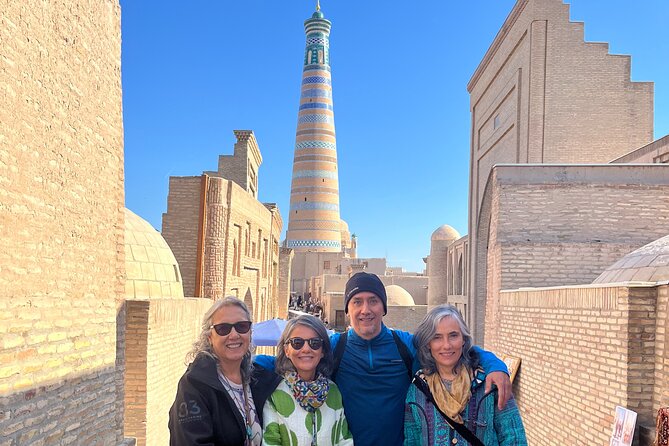
The tour ends with the Islam Khodja complex, focusing on the Islom Khodja Madrasah and its tallest minaret. Like the stone palace, this entry is marked as not included.
It’s described as built in the 19th century and named after Islom Khodja, a prominent figure in the region. If you like skyline moments, this is your “final anchor.” Minarets do more than look good. They help you orient yourself within the city’s shape.
And it makes the loop feel complete. You started at a major gate, you saw schools and a fortress, you visited craft and worship spaces, and then you finish with a religious monument that defines the horizon.
Price and the museum-ticket reality check
The tour costs $22 per person, and it’s listed as including an English-speaking guide plus a mobile ticket. The key detail is admissions.
You’ll pay an entrance fee of 250,000 sum per person, covering 10 to 13 museums. This is listed as not included, and you can pay cash or by card.
How to think about the value:
- If you plan to visit multiple sites inside Itchan Kala anyway, this ticket approach can be efficient.
- The tour saves you time by bundling the core stops into one route with interpretation, so you’re not paying for a “walk only” experience.
- If you only want to see one or two major buildings, you might question whether you need the full museum ticket.
In short, the price is fair for what you get, as long as you treat the museum ticket as part of your budget.
Group size, pacing, and what 3 hours really feels like
With a maximum of 15 travelers, this is built for manageable group movement. In a place like Itchan Kala, smaller groups are a big deal. They help you stop at the right moments without the guide constantly trying to herd people along.
The tour time is about 3 hours, which tends to feel like:
- a steady walking rhythm between stops
- short orientation explanations at each landmark
- enough time to look closely and take photos
- a final loop back to the same meeting point
Because the tour includes many distinct sites, wear shoes you can trust. Cobblestones and narrow lanes can surprise you, especially if you’re carrying camera gear.
Also bring a light layer if you’re going in cooler months. Stone interiors and shaded courtyards can feel colder than you expect.
Who this tour is for, and who should skip it
This is a great fit if you want:
- a guided understanding of Khiva’s main monuments
- a local, English-speaking perspective from Sarvar, not generic audio-guide blur
- a mix of religion, power, and craft, not just one category of sights
It’s especially good for first-time Khiva visitors who don’t want to build an itinerary from scratch.
You might choose another format if:
- you dislike paying separate admission fees
- you want a very flexible slow pace with lots of free time at just one site
- you prefer fewer stops and more lounging
But if you like efficient, well-connected walking tours where each stop answers a question, this one makes sense.
Should you book Old Khiva Stories with Sarvar?
Yes, if you want Itchan Kala to make sense quickly and you like guides who can turn buildings into stories you remember. The combo of major landmarks and the wood carving workshop gives you both the big picture and the craft reality.
Book it with the museum ticket in mind, and you’ll feel like you got your money’s worth. Also, if you care about English explanations and a genuinely helpful local style, this tour is clearly designed around that. Start early in your Khiva stay if possible, because the orientation inside the walls helps you explore on your own afterward.
FAQ
What is the price of the tour?
It costs $22.00 per person.
How long is the walking tour?
The duration is about 3 hours.
What is included in the tour price?
You get an English-speaking guide, and the tour uses a mobile ticket.
Are entrance fees included?
No. Entrance fees are not included in the tour price. You should pay 250,000 sum per person for the museum tickets, which cover 10 to 13 museums.
Where does the tour start?
The meeting point is at the Ichan Kala west gate, listed as 99H4+CRQ, Khiva, Xorazm Region, Uzbekistan.
Where does the tour end?
It ends back at the meeting point.
How large is the group?
The tour has a maximum of 15 travelers.
Can I cancel and get a refund?
Yes, you can cancel for a full refund if you cancel up to 24 hours in advance of the experience start time.
Latest reviews out of Khiva
- Khiva: classic Half-Day Tour★ 3.7 · 3 reviews
- Khiva: City Highlights Guided Walking Tour★ 4.6 · 3 reviews
- Master Class – Uzbek Bread (Khiva)★ 3.5 · 4 reviews
- Traditional Khiva Cooking Class with Market Visit & Lunch★ 5.0 · 4 reviews
- A Night In The Kyzylkum Desert [2] From Khiva★ 4.5 · 3 reviews
- Khorezm Fortress and KyzylKum Desert Private Tour★ 5.0 · 3 reviews
- Kunya Urgench Day Tour from Uzbekistan★ 1.3 · 3 reviews
- Kunya Urgench-Darvaz-Ashgabat Tour from Uzb 2 Days/ 2 Nights★ 2.9 · 5 reviews
Khiva Tours, compared.
Transfer: Bukhara – Khiva via Ancient Fortresses
Read our review →
Khiva Historical City Highlights Guided Walking Tour
Read our review →
Private Daytrip to 7 Ancient Fortresses of Khorezm
Read our review →
From Khiva To Aral Sea 2-Days One Night In Yurt Stay
Read our review →Browse the lists this tour appears in