
Tashkent is the kind of city that never sits still. It mixes tsarist-era architecture, Soviet-era power spots, and a modern, Europeanized city center in the same walkable day. Add the metro stations that feel like an underground museum, plus a real old-city bazaar, and you get a surprisingly complete snapshot of Uzbekistan.
I especially like how the tour connects places to stories you can actually use, from how power shifted across regimes at the main squares to why certain buildings were built where they were. I also like that the guide energy matters, with top reviews naming guides like Ali, Muhammad, and Ibrohim for clear explanations and friendly pacing.
The main drawback to plan for: most stops are photo stops and guided viewing, so you will not spend long time inside buildings. Also, entrance tickets are not included, so if you want to enter optional spaces, you may need to budget a little extra.
Key things that make this Tashkent Walking City Tour worth your time

- Architecture across eras in one circuit, from Amir Timur Square to tsarist-style remnants
- Chorsu Bazaar for a hands-on feel of an Eastern market in the old city
- Metro Tashkent with stations that are unique, not cookie-cutter repeats
- Hazrati Imam complex for madrassas, mosques, and a rare Holy Quran manuscript
- A guide who steers you through culture and religion, not just dates and names
Start at Hotel Uzbekistan, then let the city show its layers

The tour starts at the Hotel Uzbekistan area, and it is easy to find once you know the landmark. If you come by metro, take the red line to Amir Timur station, then walk toward the hotel entrance. This is the kind of meeting point that saves time, especially if it is your first day in town and you are still figuring out sidewalks.
Pace is a big part of the value here. It is a walking city tour, but it is not a boot camp. You get a rhythm of short sightseeing blocks, photo stops, and guided context, with enough flexibility that people who were jet lagged still felt it was manageable.
Plan around the weather. In summer, the tour notes that starting earlier can help, and it makes sense. If you tend to get heat-slow, go with a morning start and wear shoes you trust.
One more practical note: this is priced for a group up to 2 people. That makes it a good fit if you want a private guide feel without paying for a bigger group.
More City Tours in Tashkent
- Tashkent City Tour
★ 5.0 · 121 reviews - Tashkent: City Tour
★ 4.8 · 52 reviews - Tashkent : Classic City Tour. (Day & Night Shift)
★ 4.8 · 52 reviews
Amir Timur Square: modern Tashkent, with Soviet-era ghosts

You begin at Amir Timur Square, the heart of modern Tashkent. This is the place where you see how the city presents itself now, and how much that presentation is built over older political eras.
It is not just monuments. The square is tied to early institutions, including the formation of the first University and the Bank of Central Asia. And the symbolism has changed over time, including past monuments to Stalin and Marx, with the current monument to Tamerlane anchoring the story.
If you like reading a city visually, you will enjoy this stop. You can look at the same open spaces and understand how different regimes tried to define what mattered. This is also a great first photo moment, because it sets the visual language for the rest of the walk.
Time here is about 30 minutes, with guided viewing and a photo break. That is the right amount. You learn what you are looking at before you move into smaller streets and market spaces.
Broadway Alley Sayilgoh: from swamp to tsarist square

Next comes Broadway Alley Sayilgoh, often described as the Broadway of Tashkent. It is a long, walkable public space, but the history underneath it is the fun part.
The area used to be a huge swampy place. Then, under Governor-General Von Kaufman, it was transformed into a square for tsarist soldiers and their families. Local residents were also allowed, which matters because it shows how the city kept mixing new influences with existing life.
This stop is a reminder that urban design decisions shape daily life for decades. A wide avenue is never just an avenue. It is an old policy choice turned into a new habit.
Expect photo time and guided context. It is not a stop where you need to buy anything or enter anywhere. You just walk it, look around, and let the guide connect the dots.
Navoi Opera Theater: where folk art meets neoclassicism

Then you reach Alisher Nava’i Theater (the Opera and Ballet Theater). This is one of those buildings that instantly tells you you are not in the same architectural mindset as older Islamic cities you may have seen elsewhere.
It is described as the first opera and ballet theater in Central Asia, and one of Tashkent’s visit cards today. The design is also known for combining folk art elements with neoclassicism, so you get a hybrid look rather than one strict style.
Why this matters for you: when you travel, it helps to understand that Central Asian cultures did not stay frozen in one aesthetic. They adapted. This theater is a visible example of that adaptation.
You get another 30 minutes here for photo stop and guided sightseeing. If you are into architecture, this is a highlight because the building is dramatic enough to enjoy even if you only photograph it from the outside.
More of Tashkent worth pencilling in
- Tashkent Walking Tour with Local Lady / Gentleman
★ 4.5 · 29 reviews - Tashkent Walking & Food Tour: Highlights + Local Flavors
★ 5.0 · 18 reviews - Tashkent Walking Tour
★ 4.5 · 7 reviews - Tashkent City Highlights Guided Walking Tour
★ 5.0 · 6 reviews
The tsarist palace and Independence Square: political power mapped to street corners

Two more stops deepen the “who ruled what” theme, in different ways.
First is the palace of Grand Duke Nicholas Constantinovich. You get time for photo and guided viewing (about 20 minutes). This is another architecture-forward moment, showing the colonial-style presence linked to tsarist power.
Then you move to Independence Square (Mustaqilliq Maidoni), the country’s main square. Here, the guided story shifts from foreign architecture to national identity. The square now symbolizes Uzbekistan’s independence, and it is surrounded by administrative offices connected with the Cabinet and the Senate. But the earlier layers are part of the lesson too, since this was once the administrative center under Russian tsarist and communist regimes.
You will feel the emotional contrast just by standing there. Open space, big government buildings, and monuments can feel abstract, until your guide explains what changed and what stayed.
Time at Independence Square is about 20 minutes, with guided viewing and a photo stop.
Alisher Navoi area: a longer pause for names, monuments, and meaning

After that, you spend around 40 minutes at Alisher Navoi. This part of the route is less about one single building and more about soaking in the way the city honors cultural figures and organizes public space around them.
If you are the type who likes a tour that teaches you to “read” a city, this stop works. You get time for guided context and photos, and you are not rushed through it.
One practical tip: bring your scarf along. Even when stops are outside, it becomes useful when you approach religious sites later.
Metro Tashkent: the underground museum effect is real

One of the big surprises in Tashkent is how the metro turns into sightseeing. The tour highlights Metro Tashkent as an “underground museum,” and that description fits the experience.
You do not just pass through stations. You see that each station has its own distinct design, with no two stations matching the same decor style. That makes the metro ride feel like a moving gallery, and your phone will get another workout.
You will also get guidance on how to experience it properly, so it does not feel like you are just riding the train without meaning. Reviews also align with the idea that people come away with a strong sense of how the metro fits into Tashkent identity, not just as transport but as culture.
If you are short on time in Tashkent, I actually like this element for you. It gives you “wow” architecture with relatively efficient logistics, right in the middle of a walking route.
Chorsu Bazaar: the old-city market where real life actually happens

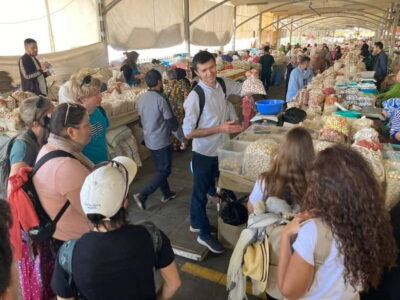
No Tashkent day feels complete without Chorsu Bazaar. This is described as the oldest bazaar in Uzbekistan, and it functions as the heart of the old city, a true Eastern market inside the modern city.
The time here is around 40 minutes, including a food market visit. For you, the value is simple: you are not only looking. You are getting the feel of the market rhythm, the colors, the scents, and the everyday economy of people buying and selling.
A practical reality check: bazaar items are typically negotiable. Even with a guide helping with interactions, you should still expect that prices may not match what you consider a budget bargain. If you plan to shop, decide what you will buy in advance so you do not get swept into impulse purchases.
Also, plan to bring cash if you want to buy snacks or small gifts. One of the clearest tips from the field is that shopping and food at the bazaar works best with cash in hand.
This stop is also a great place to ask your guide how local life actually works. Bazaar conversations often lead to the most honest cultural context you will hear all day.
Hazrati Imam complex: madrassas, mosques, and a rare Quran manuscript

The tour ends with a heavier, more spiritual note at Hazrati Imam, a historical architectural complex that is one of the city’s most important pilgrimage places.
You can expect a guided visit with photo stops and sightseeing, plus free time for shopping and extra exploration (about 1 hour). The complex includes madrassas like Barakhan and Tillesheyh, mosques, and a mausoleum tied to one of the first imams of Tashkent.
The most extraordinary detail here is religious and historical. Hazrati Imam is said to be home to a Quran manuscript from the 7th century, described as the only one of its kind in Central Asia and one of the four known manuscripts.
That matters because it changes how you experience the space. This is not just “a pretty religious site.” It is a living place with recognized sacred value, and your guide will help you understand why people treat it as more than a monument.
Dress matters here. Keep your scarf ready for respectful coverage, and wear comfortable clothes you do not mind adjusting.
This is also a smart final stop because it gives you time to slow down. Walking tours can start to feel like speed-running. Hazrati Imam gives you the chance to breathe, look closely, and choose what you want to spend your last hour on.
Price and value: $90 per group up to 2 for a focused city orientation
At $90 per group up to 2, this tour can be excellent value if you are traveling as a couple or with a travel partner you trust to share attention during photos.
The big reason is the guide. You are paying for someone to connect architecture, religion, and political history in a way that helps you leave with real orientation, not just a list of names. The guide language options are also solid, with English, Spanish, French, German, and Russian available.
What is not included is also clear. Entrance tickets are not included, so if you plan to go inside ticketed areas, budget extra. There is also a mention that ticket line help is part of the experience, which can reduce friction when a site does require entry.
As for time, it is set for 5 hours, but you should not treat that as a strict stopwatch. One practical consideration is that walking tours can run a bit longer depending on the pace of stops, questions, and the day’s conditions.
Overall, this pricing works best when you want a high-impact first-day orientation and you do not want to spend your limited time in Uzbekistan figuring out how all these sights connect.
Who this Tashkent Walking City Tour suits best
I think this tour fits you if:
- You want a first-day orientation to Tashkent’s old and modern layers.
- You like architecture and public spaces, not only museums with long ticket lines.
- You want to see Chorsu Bazaar and the metro underground museum without getting lost in transport questions.
- You prefer a guide who can explain cultural and religious context as you go.
It may be less ideal if:
- You want lots of time inside buildings or churches, temples, or museums.
- You plan a deep, hour-by-hour archaeological style visit. This is more about a guided city walk with meaningful stops than a full interior crawl.
Should you book the Tashkent Walking City Tour?
If you want a smooth, guided way to understand Tashkent fast, I think this is an easy yes. You get a strong mix: modern power at Amir Timur Square, tsarist-style architecture moments, a major cultural landmark at Alisher Nava’i Theater, market life at Chorsu Bazaar, and a spiritually significant finale at Hazrati Imam. Add the metro stations, and the day has enough “wow” to justify the time.
Book it especially if you are the kind of traveler who likes questions. Guides named in top feedback, like Ali, Muhammad, and Ibrohim, are repeatedly praised for clear storytelling and patient pacing, which turns a city walk into a real understanding exercise.
FAQ
Where does the tour meet?
The meeting point is at the Hotel Uzbekistan entrance.
How long is the Tashkent Walking City Tour?
It lasts 5 hours.
What does the $90 price include?
The price includes a professional guide (available in English, Spanish, French, German, and Russian). The group is described as private, and the price is per group up to 2.
Are entrance tickets included?
No. Entrance tickets are not included.
Do we visit the metro and see the metro stations?
Yes. The tour includes seeing Metro Tashkent, described as an underground museum with impressive stations.
Is the tour private?
Yes. The tour is offered as a private group.
What languages are available for the guide?
Guides are available in English, Spanish, French, German, and Russian.
What should I bring?
Bring comfortable shoes, comfortable clothes, and a scarf for respectful coverage, especially near religious sites.
Is the tour wheelchair accessible?
Yes, the tour is listed as wheelchair accessible.
Latest reviews out of Tashkent
- Tashkent Mountain Tour Amirsoy with Transport★ 3.5 · 3 reviews
- Private Intercity Transfer Tashkent – Samarkand – Tashkent★ 3.5 · 3 reviews
- Amirsoy & Chimgan mountain tour from Tashkent★ 5.0 · 3 reviews
- Tashkent: 3-Day Horseback Riding Tour in Chimgan Mountains★ 4.4 · 3 reviews
- Transfer Tashkent Airport / Railway Station – Hotel★ 3.5 · 3 reviews
- Private Tashkent City Tour★ 5.0 · 3 reviews
- Heliocomplex “Institute of the Sun” – Remnants of USSR★ 5.0 · 3 reviews
- Oriental Tastes of Tashkent: A Gastronomic Journey”★ 5.0 · 3 reviews
Tashkent Tours, compared.
Best of Tashkent Mountains: Amirsoy, Chimgan & Charvak Trip
Read our review →
Samarkand One Day Tour – Departure From Tashkent
Read our review →
2 Days Tour to Bukhara and Samarkand from Tashkent by train
Read our review →
Browse the lists this tour appears in