
Reviewed · TASHKENT TOURS
Bukhara One Day Tour – Departure From Tashkent
A one day trip to Bukhara is interesting because you get the feel of a medieval city without spending days on transit. You start early in Tashkent, roll into Bukhara by high-speed train, then spend the day inside mosques, madrassas, mausoleums, and the Ark fortress, before flying back the same night.
I especially like that this tour handles the hard logistics for you. You get round-trip transport plus admission fees and lunch, so your day stays focused on the sights instead of planning. I also like the private setup, so you can go at your own pace inside each stop window with your guide steering the story.
One thing to consider is the schedule density. This is a long day, and some stops are time boxed, so if you want a slow, lingering visit (or extra shopping time), you might feel a bit rushed.
Key things to know before you go
- High-speed train + same-day flight: Afrosiyob out, flight back, so you see Bukhara and still sleep in Tashkent
- All entrance fees included: you do not have to pay for each mosque or madrasa site
- Carpet museum and Trading Domes: you get cultural context plus a very hands-on market experience
- A guided route through major complexes: Lyabi Khause, Po-i-Kalyan, Ark, and the Samanids
- Private tour, your pace: it is only your group, not a big cattle herd
- Long travel day: you will start at 7:00 am and likely return around midnight
A One Day Bukhara Trip That Actually Fits Into Your Schedule
Let’s be real. Bukhara is the kind of city where time slips away fast. But this Bukhara one day tour from Tashkent is designed for people who want the highlights without turning the trip into a week-long project.
The core idea is simple: you travel out by Afrosiyob on schedule, then you walk through the historic center with a guide. Instead of choosing between the Ark, the domes, and the major mosque complexes, this tour aims to hit them all in one day. That is the value for a short trip.
There is also a practical upside. Because your guide is handling the flow between stops, you get fewer awkward gaps. You spend less time figuring out routes and more time looking closely at architecture, inscriptions, and layout.
More of Tashkent worth pencilling in
- Samarkand One Day Tour – Departure From Tashkent
★ 5.0 · 313 reviews - All in One Day Tour of Samarkand from Tashkent
★ 5.0 · 34 reviews - 1-Day Tour of Samarkand from Tashkent
★ 4.5 · 19 reviews
Price and Value: What You Really Pay For
At $249 per person, this is not a budget excursion. But the price starts to make sense when you look at what is bundled.
You get:
- Train tickets from Tashkent to Bukhara (economy class)
- Flight tickets from Bukhara to Tashkent (economy class)
- Entrance fees for all sightseeing stops
- All transportation
- Lunch
Those are exactly the items that usually inflate a short trip. Local transport is rarely just “a driver.” Train and flight tickets are usually where you have to do the most guesswork and timing juggling. Here, you hand it off and the day runs.
Also, the tour is private, which usually means your guide time is not split across a big group. For architecture-heavy days, that matters. You can ask questions, and you do not waste time waiting for everyone to catch up.
My take: if you want Bukhara in one day and you prefer convenience, this price is fair. If you want the kind of trip where you wander for hours and never feel time pressure, you may wish you had booked two or three days instead.
Afrosiyob Timing and the Same-Day Return Flight
The day starts very early. You transfer to the Tashkent Railway Station at 06:30, and the Afrosiyob train leaves at 07:30, arriving in Bukhara at 11:17. Even though it is early, the schedule is built to give you a chance to rest on the train, then land in Bukhara ready to start exploring.
In the evening, after the full-day sights, you are transferred to the airport and fly back to Tashkent. You should meet your driver at the airport and get to your hotel or home. Expect arrival back in Tashkent around midnight.
There is one “just in case” note: on rare occasions when the high-speed train is unavailable, they replace it with a regular train in the most comfortable available class. That matters because it shows they plan for continuity, not just the ideal scenario.
So yes, this is a long day. But it is a long day with an organized structure, not a chaotic scramble.
Your Guide, Your Pace, and a Marathon of Major Sites
This is a private tour/activity, meaning only your group participates. That tends to improve the experience because your guide can shape the pacing to your interests during the time windows.
The tour runs through a concentration of Bukhara’s most famous religious and educational buildings. You are moving between:
- mosques and madrassas
- mausoleums and sacred springs
- the Ark fortress, plus the trading domes and market squares
The “go at your own pace” promise is real, but it is not unlimited freedom. Each stop has a planned time slot, so your pacing happens inside that structure. If you want lots of photos and detailed looking, you may find you use the time efficiently. If you want deep conversations at every doorway, you may need to accept that you cannot do everything equally long.
A moderate physical fitness level is recommended, which is code for: you will be walking, often in old-city areas with uneven surfaces. Bring comfortable footwear and be ready for a day where you sit down only when the program stops you.
An easier afternoon once Tashkent is done:
- Best of Tashkent Mountains: Amirsoy, Chimgan & Charvak Trip
★ 4.8 · 567 reviews - Samarkand One-Day Tour Departure from Tashkent
★ 4.7 · 171 reviews - Tashkent: Amirsoy Resort, Chimgan Mountain and Charvak Lake
★ 4.8 · 170 reviews - Explore Amirsoy, Chimgan & Charvak – A Full-Day Mountain Tour
★ 5.0 · 158 reviews
Lyabi Khause Ensemble, Attori Mosque, and the Four-Minaret Stop
Your first stretch is all about central old-city layout: squares, ensembles, and the kind of architectural grouping Bukhara does so well.
Lyabi Khause ensemble
This stop focuses on Lyabi-Khauz, an ensemble shaped by three monumental buildings: Kukeldash Madrasah to the north, khanaka and Nodir Divan-begi to the west, plus the square closed off from the south by Trade Street. The description also notes that the center of old Bukhara became a reservoir, which helps you see this place as functional, not just decorative.
Why it matters: ensembles like this are the easiest way to understand how Bukhara arranged public life around learning and religion. You are not only seeing buildings, you’re seeing the idea of a city center.
Magoki Attori Mosque and the carpet museum
Next is the Magoki-Attori Mosque, described as an urban mosque in a residential quarter. It is a shorter stop, but it gives you that “real neighborhood” feeling compared with the big showpiece complexes.
You also get a carpet museum here. That is a smart pairing because Bukhara is not only about architecture. It is also about crafts and everyday art forms, and a carpet collection can make the story more tangible.
Possible drawback to consider: if you are not into markets or museum displays, you might want to focus your attention on the mosque structure and keep your time tight.
Chor Minor Madrasah
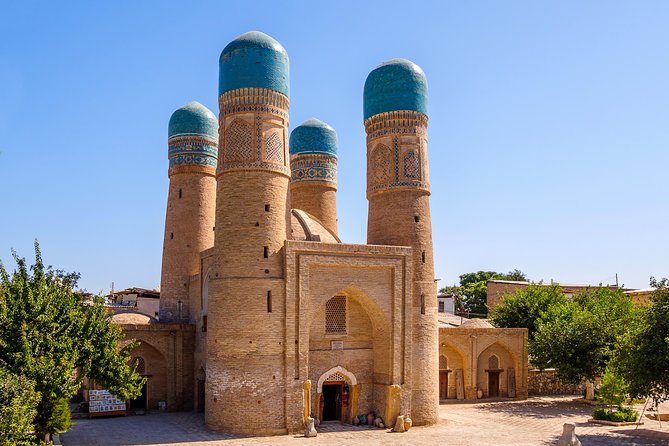
Just behind Lyabi Khause is Chor-Minor Madrasah, named for its four minarets with blue domes. The minarets differ in decoration from each other, which is a great detail to look for. Even in a short visit, you can get value by spotting how the same architectural element appears in variations.
For photos, this is one of those stops where you can often frame multiple features quickly. For understanding, it gives context for why madrassas were both schools and visual statements.
Trading Domes and the Kalyan Complex: Market Energy Meets Power
After the Lyabi Khause area, you get a shift. This is where Bukhara feels like a living system again.
Trading Domes
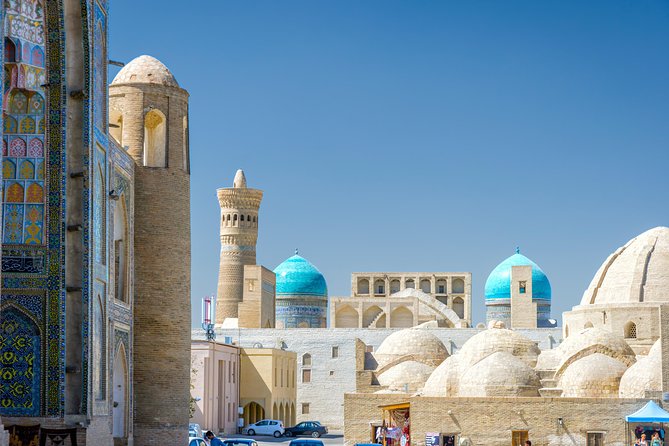
The Trading Domes are described as a massive hexagonal complex under a spherical dome. Inside, shops sell items like knives, jewelries, music instruments, and remembrances.
This stop is valuable because it adds a layer beyond architecture. You see what people buy and what goods have long been associated with the city’s trading culture.
A practical consideration: some visitors feel shopping can eat time. If you prefer pure sightseeing, set your expectation early that you will likely spend part of this stop looking through stalls. Use the time intentionally, and keep moving when you’ve found what interests you.
Kalyan Minaret and Kalyan Mosque (Po-i-Kalyan)
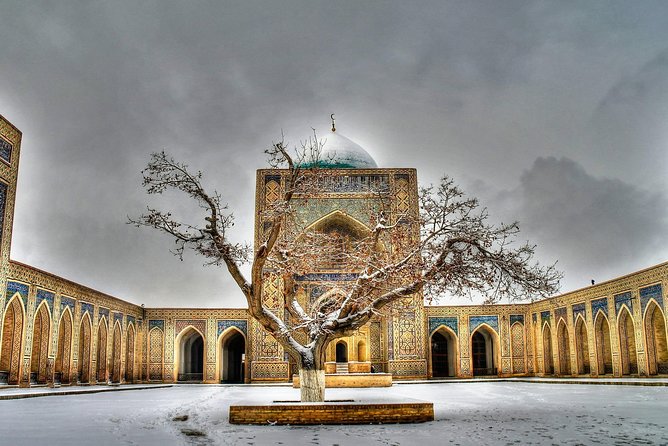
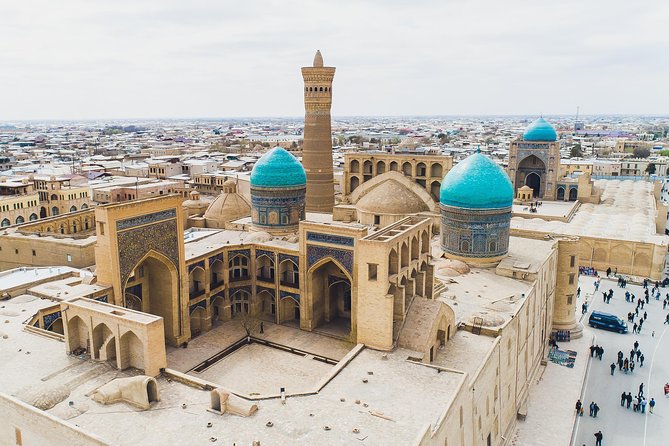
The Kalyan Minaret is called one of the most prominent landmarks in Bukhara, part of the Po-i-Kalyan mosque complex. Then you move to the Kalyan Mosque, dating back to the fifteenth century.
Why this pair works: you see the vertical landmark (minaret) and the larger worship space (mosque). That contrast helps you understand the role of monumental design in shaping the skyline and guiding where people gather.
Even if you only spend about half an hour at each, this is where the city’s “big moments” live.
Mir-i-Arab Madrasa
Next is Mir-i-Arab Madrasa, described as still an acting institution where future imams and religious mentors receive education. That note changes the vibe. You are not only looking at old stone, you are seeing a site tied to living teaching.
If you like architecture that has function, this stop lands well.
Ulugbek Madrasah
Then Ulugbek Madrasah, built in 1417, is known for harmonious proportions and a look that feels impressive even with little decoration. This is a great stop if you enjoy structure and symmetry more than surface ornament.
The description also notes that it served as an example for builders of Islamic schools in other Central Asian cities. That gives you a sense of influence, not just local importance.
Abdulaziz-Khan Madrasah
Finally in this cluster is Abdulaziz-Khan Madrasah, built in 1651 to 1652. It is described as the last large madrasa in Bukhara, with a four-ayvans yard and a noted unusual divergent fan of hudj groups after side ayvans, plus cupola buildings on the central axis.
In plain terms, this is a great “compare and contrast” stop. You can look at it after Ulugbek and notice how styles and planning ideas changed over time.
Ark Fortress and Bolo Hauz: Where Bukhara Held Power
Now you shift from schools and mosques to authority and governance.
Ark of Bukhara (Ark Citadel)
The Ark is the residence of Bukhara khans. Excavations indicate the citadel was on this site from the 4th century BC, and over centuries the layers grew into a man-made hill, with later buildings on top.
That timeline is the real magic here. You are standing where the city’s ruling story started, then layered into medieval life. Even for a short visit, the Ark helps anchor everything else you’ve seen, because it shows how political power and religious education sat side by side in the same cultural ecosystem.
Bolo Hauz Mosque
Across from the citadel of Ark in the Registan district is Bolo Haouz Mosque, built in 1712. It is listed as part of the UNESCO World Heritage Site for the historic city.
This stop is a good counterpoint to the Ark. If Ark is about rulership, Bolo Hauz is about sacred space in the same neighborhood. It is also a quick reminder that Bukhara’s identity is tied to preservation and recognized significance.
Ismail Samani Mausoleum and Chashma Ayub: Sacred Memory and Water
Your final stretches focus on mausoleums and a site that blends burial, faith, and water.
Ismail Samani Mausoleum
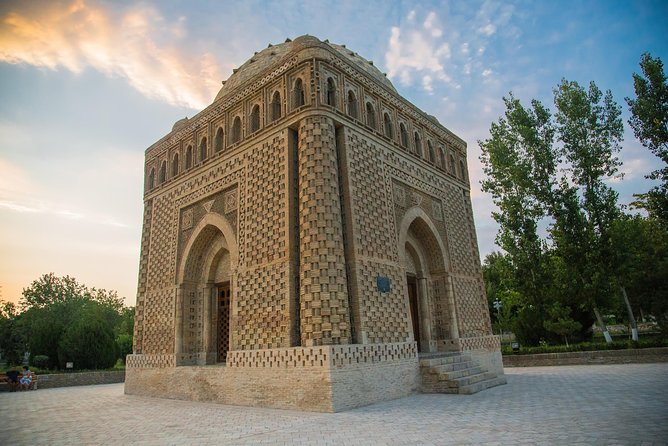
The Samanid mausoleum dates to the 10th century CE and is described as an iconic early Islamic architecture example, plus the oldest funerary building of Central Asian architecture.
Why I like this kind of stop: mausoleums often teach you how a culture wants to be remembered. Here, the building is not just important historically, it is also positioned as an architectural benchmark.
Chasma Ayub Mausoleum
Then comes Mausoleum of Chashma-Ayub, built by order of Karakhanid rulers in the 12th century. It includes a mausoleum and a holy spring, and today there is a Museum of Water as part of the site. The description says it was rebuilt several times during the 14th through 19th centuries and completed during Tamerlane’s reign.
This is one of the most interesting pairings in the tour because “water” is not a side detail. It is the reason the place is sacred. Even with a time-limited visit, this stop can feel more personal than purely monumental sites, because the water theme is practical and human.
Lunch, Breaks, and How to Survive a Long Day Without Losing Your Smile
This tour includes lunch, which is honestly a big deal on a day this packed. When transport is scheduled and entrances are planned, a real meal keeps you from turning cranky in the middle of architectural looking.
What you should do mentally: treat this as a concentrated highlight reel, not a slow museum marathon. The time slots are designed so you can see a lot and still keep energy up. On days like this, I like to save my biggest questions for the places I find most meaningful, so I do not feel like I’m rushing everywhere equally.
Also remember: you travel back to Tashkent late, around midnight. Plan your night like you mean it. After a long day of walking and standing, you will want a simple dinner and an early wind-down when you return.
What Could Go Wrong (And How to Reduce the Stress)
For most people, this tour seems to work smoothly. Ratings are strong, and a majority recommends it. The best feedback centers on good organization and a guide who can make the buildings make sense.
But two themes show up in weaker feedback, and they are worth noting because they are not about Bukhara itself.
Station and airport handoffs are where issues can appear
Some lower ratings mention stress about meeting, including not being met at the expected place in Bukhara, or confusion with a driver pickup. Another complaint says the journey never began due to a return flight seating problem on the day.
How to protect yourself:
- Keep your contact details ready and answer quickly if the operator reaches out.
- If you have any special requests, handle them early rather than at the last minute.
- Give yourself a calm mindset at handoff points, because early morning plus international logistics can make things feel sharp.
Shopping time can feel like it cuts into pure sightseeing
The Trading Domes market stop includes lots of goods. If you prefer quiet architecture time over browsing stalls, you may feel the balance shift.
Simple fix: set a goal before you enter. For example, decide what you want to look for in 5 to 10 minutes, then move on. That way you do not get pulled into a long browse when you really came for buildings.
Should You Book This Bukhara One Day Tour From Tashkent?
Book it if:
- You want a high-value highlight route in one day, with major sites covered.
- You like the idea of Afrosiyob out and a return flight so you do not burn extra days on transit.
- You prefer private guiding and a plan that handles admissions and transport.
Skip it or consider something longer if:
- You hate early starts and long travel days.
- You want hours of free time in each building, not timeboxed stops.
- You are very shopping-averse, because the Trading Domes market element is part of the experience.
My honest recommendation: if you are doing this as a short stop on a broader Uzbekistan trip, this tour is a strong way to “get your bearings fast” in Bukhara. It is efficient, structured, and packed with the architecture that makes Bukhara feel like a time machine.
FAQ
How long is the Bukhara day tour from Tashkent?
The tour runs about 12 to 16 hours, with an early start in Tashkent and a return flight late at night.
What is included in the tour price?
It includes Tashkent to Bukhara train tickets (economy), Bukhara to Tashkent flight tickets (economy), entrance fees for all sightseeing stops, all transportation, and lunch.
What time do you need to be ready in Tashkent?
You transfer to the Tashkent Railway Station at 06:30, and the Afrosiyob train departs at 07:30.
What train do you take from Tashkent to Bukhara?
You take the high-speed Afrosiyob train from Tashkent to Bukhara, departing at 07:30 and arriving at 11:17.
What happens if the high-speed train is unavailable?
On rare occasions when the high-speed train is unavailable, it is replaced with the most-comfortable class of regular train.
Is this tour private?
Yes. It is a private tour/activity, and only your group participates.
What if the weather is poor or the minimum number of travelers is not met?
The experience requires good weather. If it is canceled due to poor weather, you are offered a different date or a full refund. If the minimum number of travelers is not met, you may be offered a different experience or a full refund.
Latest reviews out of Tashkent
- Tashkent Mountain Tour Amirsoy with Transport★ 3.5 · 3 reviews
- Private Intercity Transfer Tashkent – Samarkand – Tashkent★ 3.5 · 3 reviews
- Amirsoy & Chimgan mountain tour from Tashkent★ 5.0 · 3 reviews
- Tashkent: 3-Day Horseback Riding Tour in Chimgan Mountains★ 4.4 · 3 reviews
- Transfer Tashkent Airport / Railway Station – Hotel★ 3.5 · 3 reviews
- Private Tashkent City Tour★ 5.0 · 3 reviews
- Heliocomplex “Institute of the Sun” – Remnants of USSR★ 5.0 · 3 reviews
- Oriental Tastes of Tashkent: A Gastronomic Journey”★ 5.0 · 3 reviews
Tashkent Tours, compared.
Best of Tashkent Mountains: Amirsoy, Chimgan & Charvak Trip
Read our review →
Samarkand One Day Tour – Departure From Tashkent
Read our review →
2 Days Tour to Bukhara and Samarkand from Tashkent by train
Read our review →
Browse the lists this tour appears in